

Shipping fragile and valuable products from one place to another over long distances has become a big challenge for companies all around the world. Every year, millions of dollars are lost by businesses due to products being damaged, replacing the goods, and paying the insurance claims that are all caused by the same issue. One of the most inexpensive and widely used logistics solutions, dunnage bags.
These inflatable cushioning systems have completely changed the way businesses protect their cargo during shipping and at the same time, they also have the advantage of being less costly overall in terms of shipping. It is the knowledge of dunnage air bags’ working mechanism and their strategic implementation that can change your shipping operations as well as your bottom line.
In this blog, we are going to discuss how dunnage bags help protect goods in transit while cutting down on shipping costs for businesses.
What Are Dunnage Air Bags and How Do They Work?
Dunnage bags are air-filled inflatable cushions that provide protection and stability for the cargo during transport. They are made of very strong and durable kraft paper, plastic, or woven materials and the air filling of these bags may be done either manually, through foot pumps, or by using automated inflators. After they are inflated, they are large enough to take the empty spaces left in shipping containers, trailers, and railcars, thus forming a barrier that keeps the products in place and prevents them from moving.
Types of Dunnage Air Bags Used in Shipping
Different types of dunnage solutions would be required for different shipping scenarios. The industrial dunnage bags are made of different material and sizes in order to meet specific requirements:
- Kraft Paper Dunnage Bags: These are made up of several layers (plies) of very strong kraft paper and an inner polyethylene sack. They are economical and suitable for light and medium-weight loads in dry situations, for example, truck and container shipments.
- Woven Polypropylene (Poly Woven) Bags: These bags are provided with the outer layer of woven polypropylene fabric and thus give a high level of protection compared to other bags, as they have a high tear strength and are water- and puncture-proof. They are the best option for heavy or extreme loads and are often used in rail and ocean freight.
The Role of Dunnage Bags in Load Securement
The proper way of load securement is to use a combination of different ways to stabilize and not just keep the cargo in its place. Dunnage bags are the main component of this system because they deal with the most common reason for the product’s damage: moving inside the transport container.
Preventing Lateral and Longitudinal Cargo Movement
Dunnage air bags are good in controlling movements in both ways(left to right and forward or backward) because they occupy the voids that exist between the products and the wall of the container. When placed rightly at the sides and ends of the cargo, these bags create a barrier that is resistant to friction and thus products are kept from moving. The pressure they uniformly apply makes it impossible for even tiny movements that could become serious damage over long distances through a process called accumulation.
Struggling to keep your cargo stable and damage-free? Read our blog: How Dunnage Bags Prevent Load Shifting and Cargo Damage in Transit
How Dunnage Bags Reduce Product Damage
The direct connection between dunnage bag usage and product damage reduction can be quantified through real-world logistics data. Businesses implementing comprehensive dunnage solutions report damage rate reductions ranging from 60% to 90%, depending on cargo type and implementation quality.
Cushioning Against Transport Vibrations
One of the most neglected causes of product damage is the continuous vibration during the transport. The vehicles traveling on the highways always experience low-level vibrations and, over hours or days, this can lead to products settling, cracking, or deteriorating. The problem of vibration damage is more serious especially in the case of electronics, ceramics, glassware, and precision instruments.
Dunnage air bags, totally opposite this vibration by absorbing all shock energy that would reach the products. The air suspension that is produced with the right amount of inflated inflatable dunnage bags works just like a vehicle’s suspension system in that it smoothes out vibrations. And by lessening the passage of vibrational energy, dunnage bags maintain product quality all through the shipping journey.
Eliminating Void Spaces That Cause Shifting
The principal risk factor in cargo damage during transit is the empty space found in shipping containers. Products can move, hit the container walls, or other products due to these voids. A shift of inches may cause severe damage, especially when dealing with delicate goods.
Dunnage bags reduce this risk by totally absorbing the voids, thus no place for movement is being created. When products are unable to move, they are unable to have an impact, if they do not move then they are not cracked, and hence, no damage through impact. This basic reasoning-movement prevented by eliminating voids-is also the reason industrial dunnage bags have become a must in freight management for companies dealing with valuable or fragile items.
How Dunnage Bags Reduce Overall Shipping Costs
The monetary advantages of dunnage bags are not limited to damage prevention only. Intelligent companies recognize that these products contribute to savings in various cost categories and finally lead to an increase in profit and competitiveness.
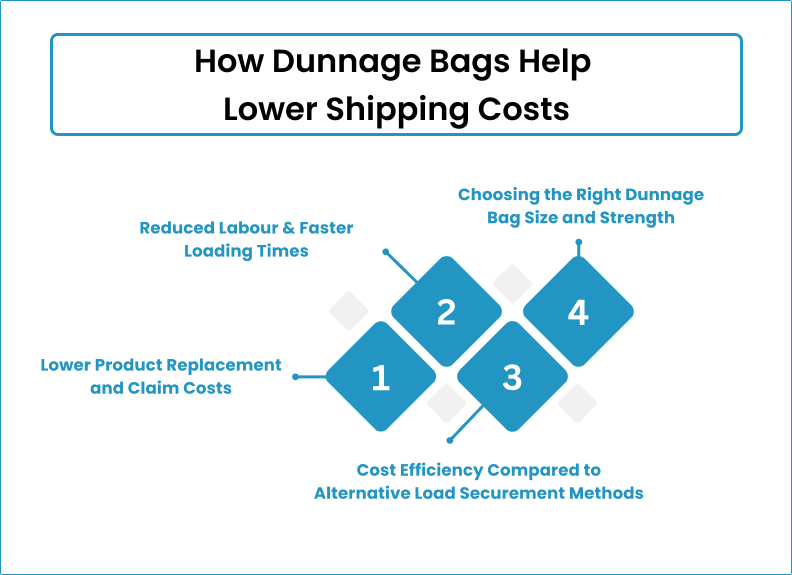
Lower Product Replacement and Claim Costs
Products that get damaged mean a loss in money directly. You will have a loss in profit from customer replacement claims, insurance deductibles, or goodwill gestures. Thus, damage rates reduction of 60-90% through dunnage bag implementation leads to direct cost savings.
Dunnage bags are widely accepted as a necessary measure by insurance companies and sometimes even give the advantage of lower premiums to companies that prove they have taken all necessary measures to protect their cargo. The indirect benefits of insurance savings are thus compounded with the direct reduction of damage.
Reduced Labor and Faster Loading Times
Dunnage air bags are a bit of a hassle at first but once they are properly used, they speed up the whole loading process. Probably the most visible difference is that workers can easily understand how to position inflatable dunnage bags instead of having to go through a complicated rigging system which requires an engineer to know how to use the tools.
Cost Efficiency Compared to Alternative Load Securement Methods
The use of traditional load securement methods like wooden blocking, foam padding, and complex bracing systems still necessitated big amounts of materials, storage, and manpower. These other options frequently require infrastructure that can be reused and professionals with specialized knowledge.
According to a comparative study, dunnage bags are usually 30-50% cheaper for each shipment than other protection methods while still being able to provide the same or even better protection. The shipping volume for the whole year adds up significantly to this cost benefit.
Choosing the Right Dunnage Bag Size and Strength
The choice of the right bag is a technical one and the determining factors include cargo, transport mode, and size of void. Bag strength is classified by the Association of American Railroads (AAR) into five levels from 1 to 5 based on rigorous burst testing done on them. Strength is also determined by ply count which in turn determines the maximum weight the bag can keep from moving.
Here is the table showing Strength & Application of Kraft Dunnage Bags:
Bag Strength (Ply / Level) | Max PSI | Max Load Restraint Capacity | Ideal Applications | AAR Level |
Level 1 / 1-Ply Bags | 2.0 PSI | Up to 30,000 lbs | Light trucking, small pallet gaps | AAR Level 1 |
Level 2 / 2-Ply Bags | 2.0 PSI | Up to 45,000 lbs | Standard trucks, container loads | AAR Level 1-2 |
Level 3 / 4-Ply Bags | 4.0 PSI | 45,001 – 75,000 lbs | Sea containers, rail “piggybacks” | AAR Level 2-3 |
Level 4 / 6-Ply Bags | 8.0 PSI | 75,001 – 160,000 lbs | Heavy rail shipments, industrial cargo | AAR Level 3-4 |
Level 5 / 8-Ply Bags | 10.0 PSI | 160,001 – 240,000 lbs | Very heavy rail/sea freight (coils, steel) | AAR Level 5 |
Polywoven Dunnage Bags – Strength & Application:
Bag Strength | Recommended Inflation Pressure | Max Load Restraint Capacity | Ideal Applications | AAR Level |
Level 1 | 2.5 – 3.0 PSI | Up to 45,000 lbs | Truck, Intermodal Sea container | AAR Level 1 |
Level 2 | 3.0 – 4.0 PSI | Up to 75,000 lbs | Truck, Intermodal Sea container | AAR Level 1-2 |
Level 3 | 4.0 – 5.0 PSI | 75,001 – 160,000 lbs | Rail, Intermodal, Ocean | AAR Level 2-3 |
Level 4 | 5.0 – 6.0 PSI | 160,001 – 216,000 lbs | Rail, Intermodal, Ocean | AAR Level 3-4 |
Level 5 | 6.0 – 7.0 PSI | for horizontal roll paper application up to 216,000 | Rail, Intermodal, Ocean | AAR Level 5 |
For the best results, the bag’s width needs to match the void it is filling perfectly. As an illustration, when an 8-inch void is present, the use of a 24-inch wide bag is mandatory, while a 36-inch bag has to be used for the case of a 12-inch void to promote the greatest surface contact and stability.
Also read on: Why Rail Shipments Require AAR-Verified Dunnage Air Bags?
Best Practices for Effective Dunnage Bag Load Securement
When dunnage bags are properly implemented, they provide the maximum protection and the best possible return on investment. The following best practices will keep your shipping operations running at top performance.
Proper Inflation and Placement Techniques
The air-dunnage bags must be inflated to the right pressure, which is normally 3 to 5 PSI, depending on the specifications of the bag. Over-inflation leads to bags bursting and creating unnecessary pressure on the cargo, while under-inflation allows the cargo to move freely and even reduces the dunnage bags’ effectiveness.
The correct positioning strategy is of similar importance. The placement of bags at the top, sides, and ends of the cargo creates a complete protective barrier. For regular trailers, the placing typically includes:
- Bags along the full length of both side walls
- Bags above cargo in trailer roof areas
- Bags at front and rear to prevent longitudinal movement
- Bags between products to prevent inter-product collision
This comprehensive placement creates multiple layers of protection, ensuring cargo cannot shift in any direction.
Conclusion: The Smart Choice for Safer, Cost-Effective Shipping
Dunnage bags solve two major logistics problems: product damage and shipping costs. The leading dunnage air bags manufacturers, Dunnage Systems Inc. that help reduce damage claims, lower insurance costs, and streamline loading procedures. By implementing industrial dunnage bags into your load securement strategy, you invest in measurable value and customer satisfaction.
Whether you’re shipping fragile electronics, automotive components, manufactured goods, or any product vulnerable to transport damage, implementing inflatable dunnage bags into your logistics operations is a smart investment. The issue here is not if dunnage bags should be used, but rather when you can incorporate them into your load securement procedures to reap these considerable cost and quality benefits.