In today’s competitive manufacturing and logistics landscape, reducing packaging expenses while maintaining their safety standards. Flexible Intermediate Bulk Containers (FIBC Bags) provide the solution because they function as heavy-duty polypropylene “super sacks” which weigh only a few pounds yet transport thousands of pounds of materials. By replacing them with smaller bags or rigid containers, these bulk bags streamline supply chains and drastically reduce costs.
FIBC bags serve as essential packaging solutions for dry bulk operations in agriculture and construction and chemical industries. The collapsible jumbo bags enable better space management in warehouses and trucks while they decrease shipping damage and boost operational efficiency. Dunnage Systems Inc. stands as a top FIBC bags manufacturer which provides businesses with solutions to achieve their maximum operational benefits.
What Are FIBC Bulk Bags and How Do They Work?
Flexible Intermediate Bulk Containers (FIBC Bulk Bags) are very large, woven polypropylene bags mainly used for storing and transporting dry, flowable materials in bulk. Also, they are called PP Jumbo bags or industrial bulk bags, and they have reinforced stitching and sturdy lift loops, which make them ideal for handling with a forklift. Materials are loaded from the top (through a spout or open) and discharged from a bottom spout, thus making the whole process very simple and efficient.
These bags weigh only 4-5 pounds and safely carry 500-2,000 kg (1,100-4,400 lb) of product. This amazing ratio of payload-to-weight leads to fewer pounds of packaging weight and more products per shipment. FIBC bags can be easily stored as flat when empty thus taking up minimum space for storage. Their flexible construction allows them to take the shape of the material, making them the cost-effective option of the middle class between small full sacks and rigid containers like drums or IBCs.
Are your FIBC bulk bags wearing out faster than expected? Learn the right storage practices in How to Properly Store FIBC Bulk Bags to Maximize Their Lifespan
Types of FIBC Bulk Bags
FIBC Bulk Bags have various types depending on the material or method of handling. The most popular types are:
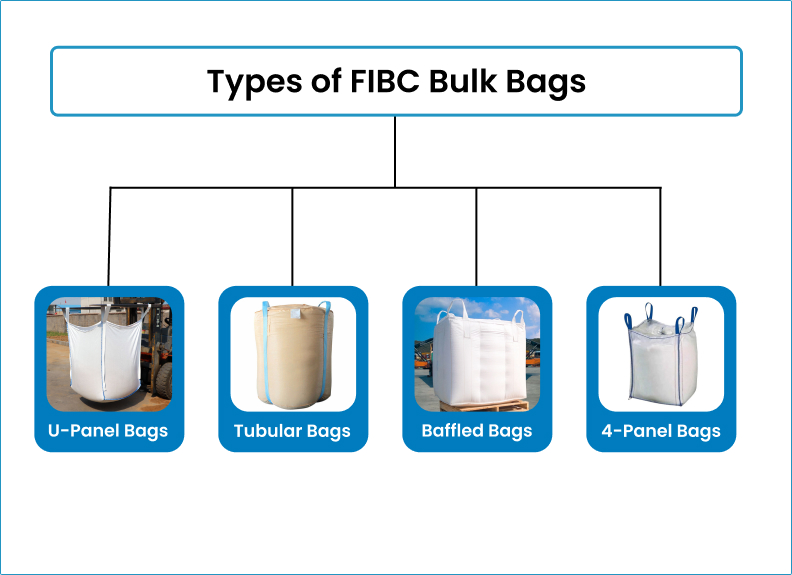
- U-Panel Bags: The bag is made of three fabric panels stitched to form a “U”. The two side panels wrap around the body making it strong. This structure is very durable, and that is why it is used for heavy load lifting.
- Tubular (Circular) Bags: A continuous tube of woven fabric forms the body of the bag with the top and bottom sewn on. The body without seams minimizes leaks thus making tubular bags ideal for the delicate powder and granular materials. The weight is uniformly distributed so that they handle loads easily.
- Baffled Bags: These bulk bags are sewn with the baffles (square panels) made out of fabric inside the bag. When the bag is filled, the baffles support the sides, thus keeping the bag square and preventing it from bulging. This results in better stacking stability and utilization of storage and transit space.
- 4-Panel Bags: Made of four side panels and a bottom panel. The bags automatically stand up straight compared to U-panel bags and can even have baffles added for more stability. They are commonly used when it is important to keep a rigid box-like shape.
Custom-made bulk bags are defined by dimensions, lifting loop styles (cross-corner or single panel), spout styles, and features such as liners, discharge spouts, or printed labels. In other words, you can have an FIBC bulk bag that is perfect for your product and process.
Key Features and Specifications of FIBC Bulk Bags
Understanding FIBC specifications helps you select the right bag for your needs:
- Capacity & Safety Rating: The majority of bags are capable of holding 1,000-4,400 lbs (0.5-2 tonnes) while custom bulk bags can handle up to 5,000 lbs. The safety factors (5:1 or 6:1) symbolize tested burst strength – a 5:1 bag endures five times its rated load.
- Material: The woven polypropylene fabric offers a combination of lightweight strength, chemical resistance, and moisture blocking. The use of polyethylene liners is optional which provides added dust and moisture barriers.
- Lifting Loops: The reinforced loops (usually four) allow safe handling by forklift or crane. Heavy-duty stitching and layered fabric make transport and stacking secure.
- Filling & Discharge: Various methods such as top spouts for conveyor filling, open tops with cinch closures, and bottom discharge spouts for quick unloading are available – the choice depends on your equipment.
- Customization: FIBC bags are offered in standard and custom sizes, besides other specialized options such as Food-Grade certification for non-processed materials, dust-tight liners, and inner baffles for shape retention.
The combination of these features renders FIBC Bulk Bags to be extremely adaptable. For example, a single bag can be certified for food use, have a dust-tight liner, and even have an inner baffle for shape maintenance – all this in a customized package.
Wondering how customized packaging can improve efficiency and product safety? Read Custom FIBC Bags: Why Tailoring Your Packaging Matters
Common Industries Using FIBC Bulk Bags
FIBC bulk bags are widely used in various industries. Some of the main applications are:
- Agriculture: The large quantities of grain, feed, seed, and fertilizers are transported and stored in the most efficient way; thus, no extra storage is needed.
- Construction: Cement, sand, gravel, and other heavy building materials will be served with strong and heavy-duty bags that are resistant to abrasives.
- Chemicals: There are FIBCs for powders, resins, and plastic pellets that can withstand chemicals, with static-dissipative options for risky environments.
- Food Processing: The use of food-grade bags guarantees the hygienic handling of flour, sugar, salt, spices, and other food ingredients.
- Mining & Minerals: Heavy-duty bags move ores, aggregates, and metal powders in tonnage quantities.
From pharmaceutical manufacturing to recycling operations, FIBC bags reduce manual handling, fit standard material-handling equipment, and integrate seamlessly into automated systems, replacing dozens of smaller containers with a single efficient solution.
How FIBC Bulk Bags Reduce Packaging Costs
Switching to FIBC Bulk Bags can drastically reduce total packaging costs in several ways. First, the unit cost per ton of material is much lower. Single FIBC can take the place of dozens of small bags or several rigid containers. The cost of packaging is minimized and hence the cost of materials and labor for handling those packages is also reduced. Moreover, FIBCs are very big, meaning that goods will get less storage, handling, and transport costs per pound of goods shipped.
Below is a comparison of common packaging methods. This table illustrates how FIBC bulk bags outperform alternatives on key cost and efficiency factors:
Feature | Small Bags (20–50 kg) | Rigid Containers (Drums/Boxes) | FIBC Bulk Bags |
Typical Capacity | 20–50 kg per bag/sack | ~50–200 kg per unit | 500–5,000 kg per bag |
Material Cost (per volume) | Low to moderate (paper/film) | High (steel, plastic, wood) | Low (woven PP fabric) |
Reusability | Single-use (disposable) | Often reusable (requires cleaning) | Highly reusable (several cycles) |
Storage Efficiency | Low (many small packages) | Moderate (fixed shape) | High (collapsible, stackable) |
Handling & Labor | Labor-intensive (manual) | Forklift/hoist for many units | Forklift with single unit |
Packaging Waste | High (many units to discard) | High (drums/disposal) | Low (fewer bags, recyclable PP) |
Long-Term Cost Efficiency: Storage and Reusability
FIBC bags not only save materials but also provide continuous cost benefits:
Maximized Storage Density: The empty bags are flattened and occupy very little space in the warehouse. The filled bags are stacked in a very efficient way because they have flexible walls that closely nest on the pallets – thus, they are maximizing the warehouse and the truck loads compared to containers with fixed dimensions that cannot be easily moved.
Built for Multiple Uses: FIBC bags for industrial purposes can handle 5-10+ cycles with heavy-duty woven polypropylene and reinforced stitching. Companies that run closed-loop return programs are able to lower their annual packaging procurement by 20% or more while also cutting down on disposal costs. The initial cost is distributed over multiple uses, resulting in a dramatic reduction of cost per load over time.
Environmental and Sustainability Advantages
FIBC Bulk Bags give not only cost savings but also offer environmental benefits that are aligned with sustainability objectives.
Reduced Packaging Waste
FIBC bulk bags significantly decrease the volume of packaging waste. The use of a single reusable bulk bag to replace several individual sacks means less discarded containers and less waste in landfills. According to companies, there is a 70-80% decrease in packaging waste disposal after they have switched to bulk bags. Moreover, since FIBCs securely keep the materials inside, the loss of products due to leaks or spills is also not possible – thus, preventing the product from being wasted.
Recyclability and Eco-Friendly Options
Polypropylene FIBC bags are fully recyclable, reprocessed into new plastic materials. Many manufacturers now offer bags with 30%+ recycled PP content, reducing new material consumption. Woven PP is easier to separate and recycle compared to mixed-material packaging, enabling a circular packaging strategy where bags are reused till worn, then recycled – reducing demand for new plastics.
Lower Carbon Footprint in Transportation
FIBC bags reduce transportation emissions by maximizing truck capacity. Their flexible design fills wasted air space, allowing more product per shipment – meaning fewer trips and less fuel consumption. The lightweight polypropylene construction (versus steel drums) increases payload efficiency. It was found by research that the life-cycle CO₂ emissions per unit shipped can be reduced by as much as 60% if bulk bags are reused which then makes FIBCs both cost-effective and environmentally friendly.
Explore our latest blog: Load Securement Tips to Maximize Safety and Efficiency in Transportation
Choosing the Right FIBC Bulk Bags for Your Business
Finding the perfect FIBC bulk bag involves not only the selection of the right design but also your specific needs:
- Capacity & Safety Rating: Determine your maximum fill weight and volume requirements, then choose bags based on the appropriate safety factors (5:1 or 6:1). If the load is heavy or critical, use high ratings and check that they are certified.
- Bag Design: Choose panel styles based on your material – tubular bags for fine powders, baffled or 4-panel bags for products requiring rigid form and stability.
- Discharge Method: Select the bottom spout diameter by how fast you want to empty it. For moisture-sensitive materials, choose sealed tops or liner options.
- Compliance Requirements: The use of FIBCs designated for food-grade or sanitary applications is a must for the food, beverage, and pharmaceutical sectors. UN-certified bags that comply with the applicable regulations should be used for chemical and hazardous materials.
By collaborating with a skilled FIBC manufacturer, you acquire the proper configuration for your application – from standard designs to custom solutions that are specifically adapted to your industry’s needs.
Best Practices for Maximizing FIBC Bulk Bags Efficiency
Proper handling practices allow you to take advantage of the cost and efficiency benefits of FIBC bags:
- Filling & Discharge: Maintain bag shape and prevent material bridging by using designated filling equipment. Fill gradually so that fabric can expand uniformly. During discharge, open bottom spouts carefully to ensure controlled material flow, which will safeguard both product and bag integrity.
- Safe Lifting: Always use all lifting loops with a forklift tines or slings – do not lift by one loop alone. Make sure the loops are fully extended and untwisted to avoid accidents.
- Storage & Stacking: Use flat pallets for bag storage in dry areas that are protected from direct sunlight to avoid UV degradation. Bags with baffles or square bases are the most stable when stacked; never go beyond the recommended stacking heights.
- Inspection & Maintenance: Check every bag before use to ensure there is no damage, loose stitching, or torn loops. Remove defective bags without delay. For reusable programs, monitor cycles and recondition bags as required to prolong service life.
- Personnel Training: Workers who receive proper training cause fewer accidents, less spillage, and less bag damage – thereby maximizing safety and the return on your FIBC investment.
Strictly adhering to these practices will help you minimize downtime, avoid losing products and capture the entire efficiency advantages of bulk bag systems.
Conclusion: The Long-Term Value of FIBC Bulk Bags for Cost Reduction and Efficiency
FIBC Bulk Bags deliver measurable cost savings by reducing packaging material, minimizing labor, and improving storage and transportation efficiency. The product serves as a dependable solution for various industries because of its ability to handle heavy loads and its simple handling features and its reusable design. The permanent PP jumbo bags provide operational benefits to businesses while they help companies achieve their sustainability targets through reduced packaging waste and decreased transport emissions.
For those companies that are committed to being efficient over the long haul, FIBC bulk bags are the perfect mix of performance, safety, and cost control. Dunnage Systems Inc. will guarantee that the bag design selected is the most appropriate for your application, thus helping in the protection of products, optimization of workflows, and reduction of total packaging costs all throughout the supply chain.