
Every FIBC bulk bag carries two numbers that decide how it can be used safely: the safe working load and the safety factor. Get them wrong, and a bag can fail while it is lifted overhead. Yet these two numbers are often misunderstood, even by people who fill and lift bulk bags every day.
This guide explains what each number means, how 5:1 and 6:1 bags differ, when a bag can be reused, and what applies to bags for hazardous materials.
What Are FIBC Bulk Bags?
FIBC stands for flexible intermediate bulk container. These bulk bags are made from woven polypropylene and are used to store and move dry, flowable products such as grains, minerals, chemicals, sand and plastic pellets. They are filled and lifted by their loops, usually with a forklift or hoist.
For an overview of designs, read what are FIBC bulk bags? Types and benefits.
What Is Safe Working Load (SWL)?
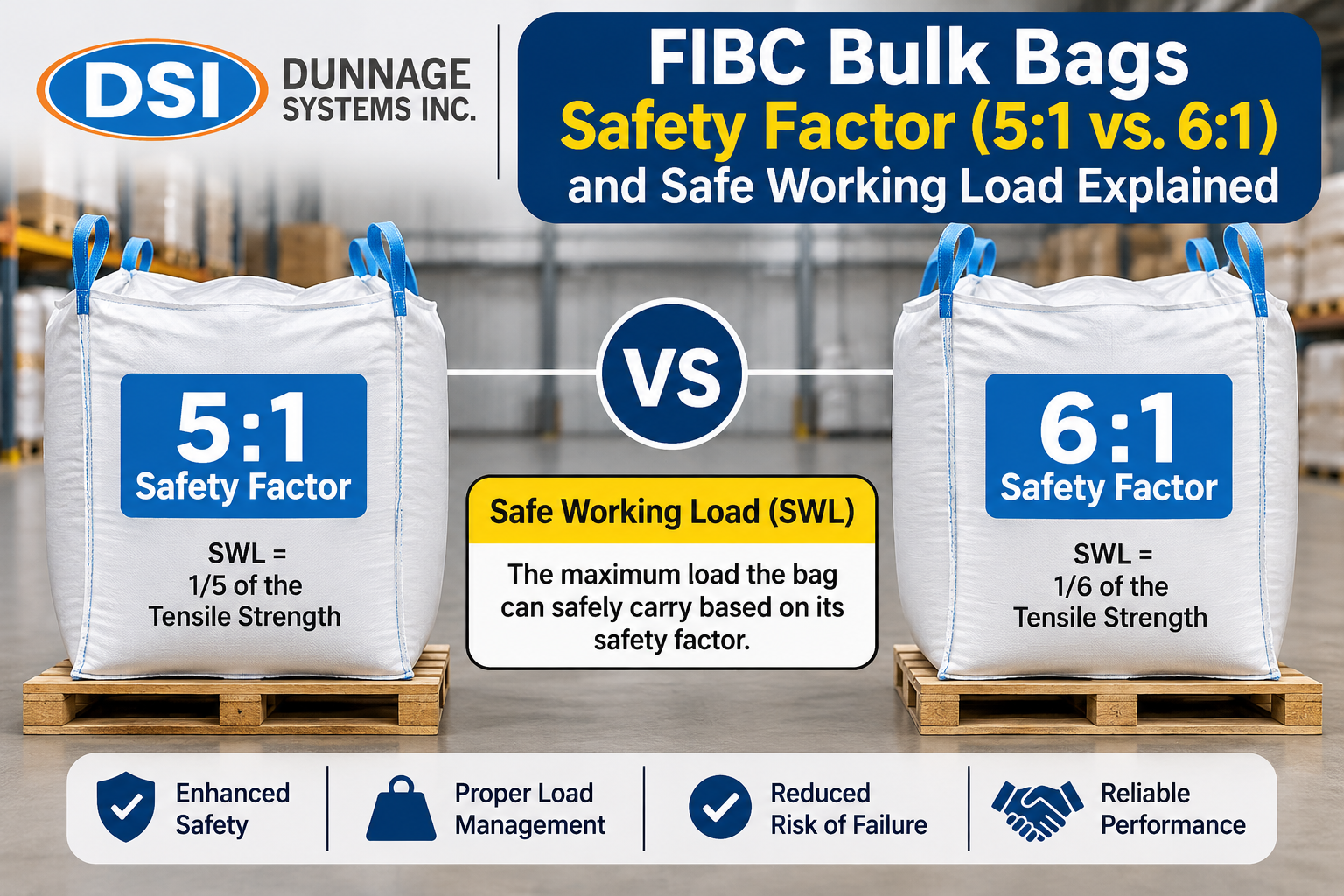
The safe working load is the maximum weight of product the bag is designed to carry in normal use. It is printed on the bag’s label.
The SWL is a hard limit. Never fill a bag above its SWL, even though the bag was tested to a higher load. The extra strength is a safety margin, not extra capacity.
Dunnage Systems’ FIBC bulk bags are available with SWL ratings from 500 kg to 2,500 kg, with custom ratings on request.
What Is the Safety Factor?
The safety factor (SF) is the ratio between the load a bag design withstood in testing and its SWL. A 5:1 bag has been tested to hold at least five times its SWL. A 6:1 bag has been tested to at least six times its SWL.
| Bag | SWL | Safety factor | Tested to at least |
|---|---|---|---|
| Example A | 1,000 kg | 5:1 | 5,000 kg |
| Example B | 1,000 kg | 6:1 | 6,000 kg |
| Example C | 2,000 lb | 5:1 | 10,000 lb |
Both bags in Examples A and B have the same 1,000 kg SWL. The 6:1 bag simply has a larger safety margin.
5:1 vs. 6:1: Single-Trip and Reusable Bags
The international standard for non-hazardous FIBCs is ISO 21898. It sets out bag classes and the testing for each, including repeated top-lift tests followed by a test to destruction.
5:1 Single-Trip Bags
Under ISO 21898, single-trip bags are rated 5:1. They are designed for one filling and one delivery. Industry guidance is clear that single-trip bags should not be reused after they are emptied, because their condition after one cycle cannot be guaranteed.
6:1 Reusable Bags
Standard-duty reusable bags are rated 6:1. They are built to be filled, emptied and refilled. Before every reuse, they should be inspected for damage, and they are typically used for the same product in the same application. Bags in a heavy-duty reusable class can carry higher ratings, such as 8:1.
Moving from 5:1 to 6:1 usually means a stronger construction, such as heavier fabric and stronger lift loops.
Which Safety Factor Do You Need?
| Your situation | Safety factor |
|---|---|
| One-way shipment, bag discarded or recycled after use | 5:1 single-trip |
| Bag will be refilled and reused | 6:1 (or higher for heavy-duty reuse) |
| Hazardous materials under DOT/UN rules | UN-certified bag; 6:1 top-lift testing |
FIBC Bulk Bags for Hazardous Materials
Bulk bags used for hazardous materials must be UN-certified. In the US, flexible IBCs are tested under 49 CFR Part 178. In the top-lift test for a flexible IBC, the filled bag plus the applied test force must reach at least six times the bag’s maximum net mass. That load is held for five minutes. UN design tests also include drop, topple, righting, tear and stacking tests.
This is why UN bags are associated with a 6:1 safety factor. Dunnage Systems offers UN-certified FIBCs for hazardous material transport, with a 6:1 safety factor.
How to Read a Bulk Bag Label
A compliant label should show:
- The safe working load
- The safety factor (5:1, 6:1 or other)
- The bag class (single-trip or reusable)
- The standard it was tested to, such as ISO 21898
- For UN bags, the UN marking code
If any of these are missing or unreadable, do not use the bag.
Safe Handling Tips
- Never fill above the SWL.
- Inspect loops, seams and fabric before each fill.
- Lift using all loops as designed; never lift by one loop unless the bag is built for it.
- Never stand or walk under a suspended bag.
- Do not drag bags or tip them by their loops.
- Store bags out of direct sunlight, since UV weakens polypropylene over time. See how to store FIBC bulk bags.
Other Specifications to Check
The safety factor is only one part of a bag specification. Also check:
- Construction: U-panel, tubular, baffled or 4-panel
- Fabric weight: Dunnage Systems offers 90 to 230 gsm
- Liners: PE, food-grade or anti-static
- Top and bottom: spouts, duffles or flat bottoms
- Static protection: if you handle flammable or combustible powders, ask about the right static-protection type
Need something specific? Read custom FIBC bags: why tailoring your packaging matters.
Frequently Asked Questions
What does 5:1 mean on a bulk bag?
It means the bag design was tested to hold at least five times its safe working load. A 1,000 kg SWL bag with a 5:1 safety factor was tested to at least 5,000 kg. You should still never fill it above 1,000 kg.
Can single-trip bulk bags be reused?
No. Single-trip (5:1) bags are designed for one use. Industry guidance says they should be scrapped or recycled after they are emptied.
Is a 6:1 bag stronger than a 5:1 bag?
It has a larger safety margin relative to its SWL and is built for reuse. Two bags can have the same SWL but different safety factors.
What safety factor do UN-certified FIBCs need?
UN flexible IBCs must pass a top-lift test at a minimum of six times their maximum net mass under US rules, which is why they are rated 6:1.
What SWL ratings are available?
Dunnage Systems supplies FIBC bulk bags from 500 kg to 2,500 kg SWL, with custom ratings available.
Choose the Right Rating Before You Lift
The safe working load tells you how much a bulk bag can carry. The safety factor tells you how much margin is built in and whether the bag can be reused. Use 5:1 bags for single trips, 6:1 or higher for reuse, and UN-certified bags for hazardous materials.
Dunnage Systems supplies FIBC bulk bags in U-panel, tubular, baffled and 4-panel designs, with UN-certified and food-grade options. Request a quote or explore our FIBC bulk bags.