
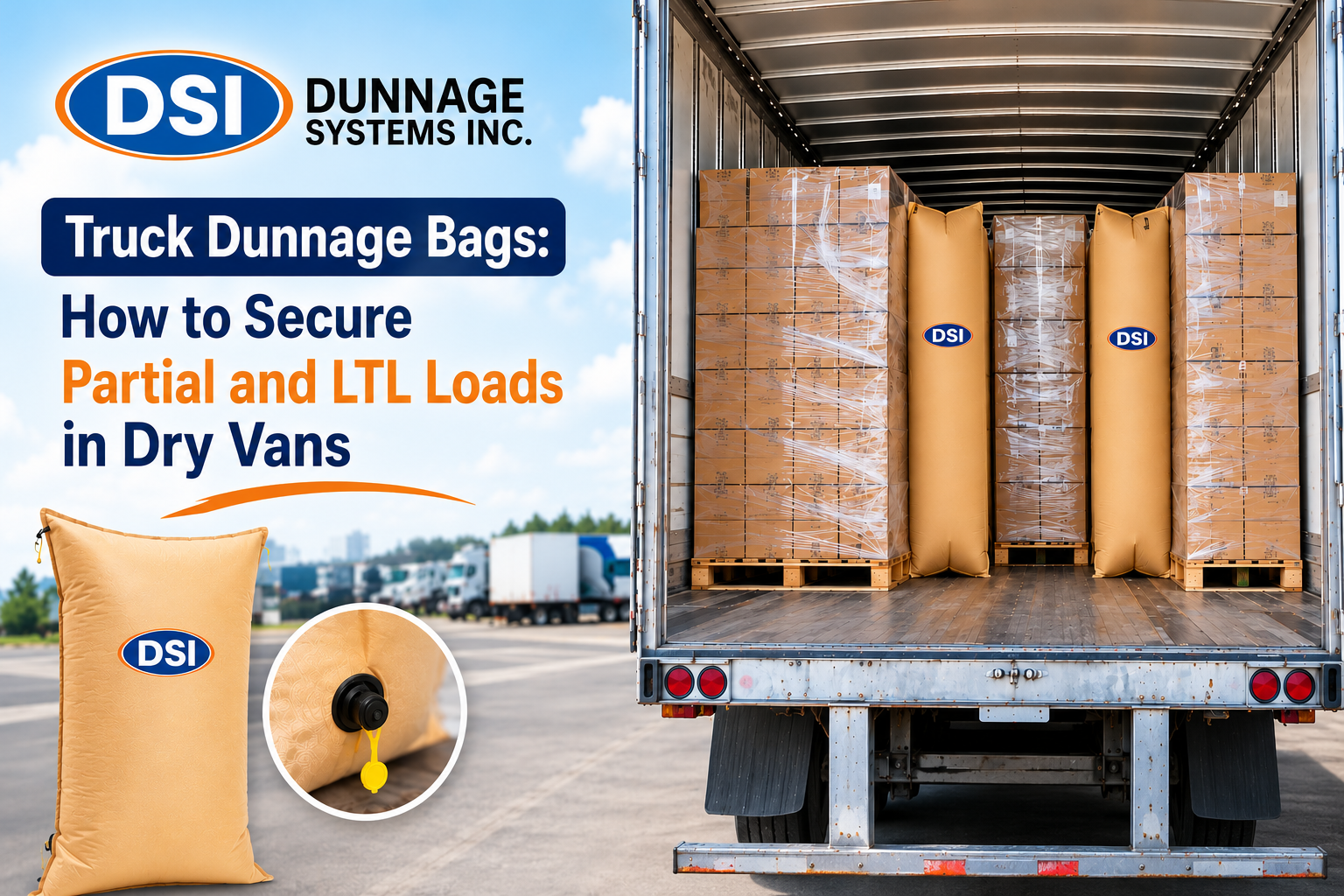
A full trailer is easier to secure than a half-empty one. When pallets fill the van wall to wall and nose to tail, there is little room to move. Partial and LTL loads are different: gaps between stacks and an empty rear give freight plenty of room to slide, tip and collide. Truck dunnage bags, combined with a good load pattern and the right bracing, keep partial loads in place.
This guide explains how to plan a partial load, where to use cargo air bags, how they work with load bars, and what to do with fragile freight.
Why Partial Loads Shift
Every truck load feels forward force when the driver brakes, backward force when pulling away, and sideways force in turns. These forces are large: federal cargo securement rules require securement systems to withstand 0.8 g of forward deceleration and 0.5 g rearward and sideways. Loose freight in a partial load has little to resist them.
In a partial load, three kinds of void cause most damage:
- Side gaps between pallets and the van walls
- Center gaps between pallet rows
- The rear void between the last row and the doors
Each one gives freight room to gain speed before it hits something. For more general advice, see our load securement tips.
Step 1: Plan the Load Pattern
Before reaching for bags, reduce the voids:
- Load tight to the front wall. The front wall is the strongest restraint in the trailer.
- Pair pallets side by side where possible, so rows fill the width.
- Spread the weight. Avoid putting all heavy freight in one spot. Keep heavier pallets on the bottom and spread weight along the trailer so no axle is overloaded.
- Keep stacks stable. Stretch-wrap pallets well and avoid stacking heavy on light.
A good pattern leaves fewer and smaller voids to fill.
Step 2: Fill Gaps With Truck Dunnage Bags
Use dunnage bags for side and center gaps between pallets. An inflated bag presses both rows outward against the van walls, so they act as one wider block.
Choosing the Right Truck Dunnage Bags
For most over-the-road freight, lighter-grade bags are enough:
- Kraft 2-ply bags are rated for truck loads at up to 2 PSI, and 4-ply for heavier truck loads. See kraft dunnage air bags.
- Polywoven Level 0 bags are rated for truck transport, and Level 1 and 2 for truck, intermodal and sea. They are reusable and moisture-resistant. See polywoven dunnage air bags.
Measure each gap and choose a bag that fits it. Our guide on how to calculate dunnage air bag size explains how.
Placement Tips
- Center the bag in the gap, from near the floor to near the top of the shorter stack.
- Keep bags clear of nails, corners and banding.
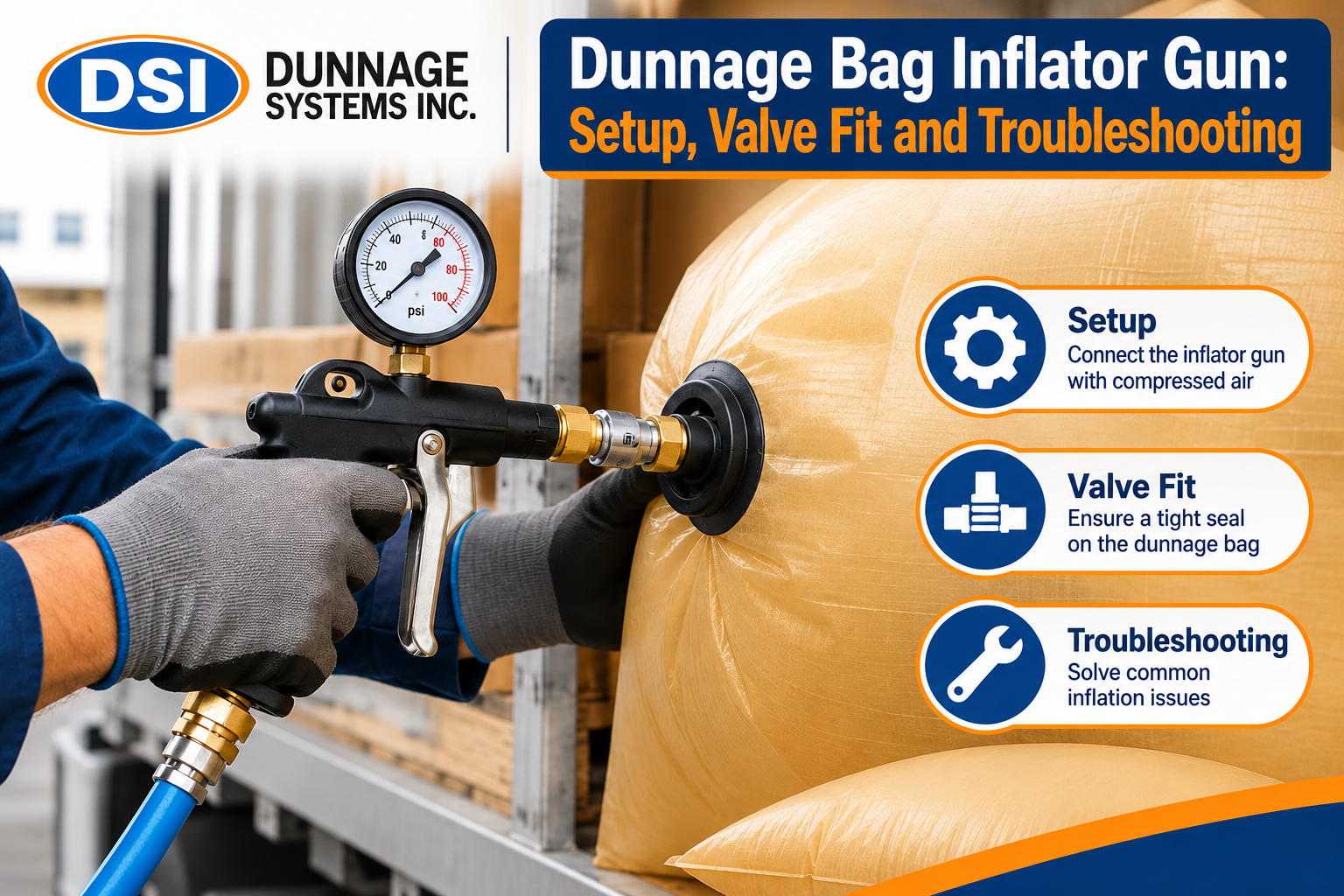
- Inflate gradually with an airbag inflator and stop when the bag fits firmly. On Dunnage Systems bags, a correctly inflated bag compresses no more than half an inch under light palm pressure.
Step 3: Block the Rear of the Load
The rear void is the biggest risk in a partial load. Freight that slides backward can strike the doors, and freight that falls against the doors can injure whoever opens them.
Do not try to fill a large rear void with a single airbag pressing on the doors. Instead:
- Install load bars or load locks directly behind the last row, tight against the freight.
- Use a rigid void filler to fill the space between the last row and a load bar where needed.
- Use dunnage bags for the gaps between rows ahead of the bar.
Load Bars vs. Dunnage Bags
| Tool | Best for |
|---|---|
| Load bars or load locks | Holding the rear of the load; separating sections in LTL trailers |
| Dunnage bags | Filling side and center gaps between pallets |
| Rigid void fillers | Large or awkward voids, including the rear void with a load bar |
| Anti-slip mats | Adding friction under pallets to reduce sliding |
Most partial loads use more than one. Anti-slip rubber mats are especially helpful on smooth trailer floors.
Securing Multi-Stop and LTL Loads
LTL trailers are loaded and unloaded at several stops, so securement has to work after each drop:
- Section the load with load bars so each customer’s freight is held separately.
- Reuse polywoven bags between stops where freight is removed, or replace kraft bags.
- Re-secure after each stop. When a section comes off, the freight behind it may now have a void.
- Load in reverse stop order so the first delivery is nearest the doors.
Dunnage Airbags for Fragile Freight
Fragile freight, such as glass, electronics and appliances, needs extra care:
- Use a smooth protective sheet between the bag and fragile packaging to spread pressure.
- Do not over-inflate; stop as soon as the bag fits firmly.
- Combine bags with corner protection and good stretch-wrapping on the pallet itself.
Read more in our guide to industrial dunnage bags for fragile products.
Frequently Asked Questions
What are truck dunnage bags?
They are inflatable bags placed in gaps between pallets, or between pallets and the trailer wall. When inflated, they press the freight outward so it cannot shift during braking, acceleration or turns.
How do you secure a partial load in a dry van?
Load tight to the front wall and pair pallets side by side. Fill side and center gaps with dunnage bags, then block the rear with a load bar or rigid void filler. Anti-slip mats add friction under pallets.
Can I put a dunnage bag against the trailer doors?
It is not recommended. A large rear void should be held with a load bar or a rigid void filler, so the doors do not carry the load.
What level dunnage bag do I need for truck freight?
Most truck freight uses kraft 2-ply or 4-ply bags, or polywoven Level 0 to Level 2 bags. Heavier or intermodal loads need higher grades.
Are cargo air bags reusable?
Polywoven cargo air bags are reusable if they pass inspection. Kraft paper bags are single-use and recyclable.
Keep Partial Loads From Shifting
Partial and LTL loads need more thought than full ones, but the method is simple. Plan the pattern, fill gaps with truck dunnage bags, block the rear and add friction where floors are smooth.
Dunnage Systems supplies truck dunnage bags, inflators, void fillers and anti-slip mats to shippers in all 50 states. Talk to our team about your load patterns, or browse our dunnage air bags.