
Sizing a dunnage air bag sounds simple until you get it wrong. Order a bag that is too small and it will not fill the void properly, which means the cargo can still shift during transit. Order one that is too large and it will not fit the space, leaving your dock crew improvising mid-load with product that cannot do its job. Either way, the freight is at risk and the order was a waste.
The good news is that calculating the right dunnage air bag size is not complicated. It comes down to three measurements, a basic matching process, and an understanding of a few factors that can affect which bag works best for your specific load and freight mode.
This guide walks you through the full sizing process, from measuring the void to matching the right bag to your cargo, whether you are loading a truck trailer, a railcar, or a shipping container.
Why Getting the Size Right Matters More Than You Think
Most freight damage in transit is not caused by rough roads or aggressive driving. It is caused by cargo shifting inside the trailer, railcar, or container because there was empty space that was not properly filled and secured. Dunnage air bags solve that problem by inflating to fill those voids completely. But they can only do that job when the bag size matches the void dimensions.
An undersized bag leaves gaps around the edges. It may hold position on a smooth road but lose contact the moment the load experiences vibration, a sharp turn, or a hard brake. An oversized bag that is forced into a tight space cannot inflate to its intended shape, which means it is not generating the contact pressure it needs to brace the load effectively.
The sizing process is also different for different freight modes. Cargo air bags used in truck trailers work under different conditions than container air bags used in ocean shipping or railcar applications. The void dimensions, the forces the bag needs to absorb, and the construction level required all vary depending on how and where the freight is moving.
Getting the size right from the start is how you protect the load, avoid damage claims, and make sure every bag you purchase is actually doing the job it was designed to do.
Step-by-Step: How to Calculate the Right Dunnage Air Bag Size
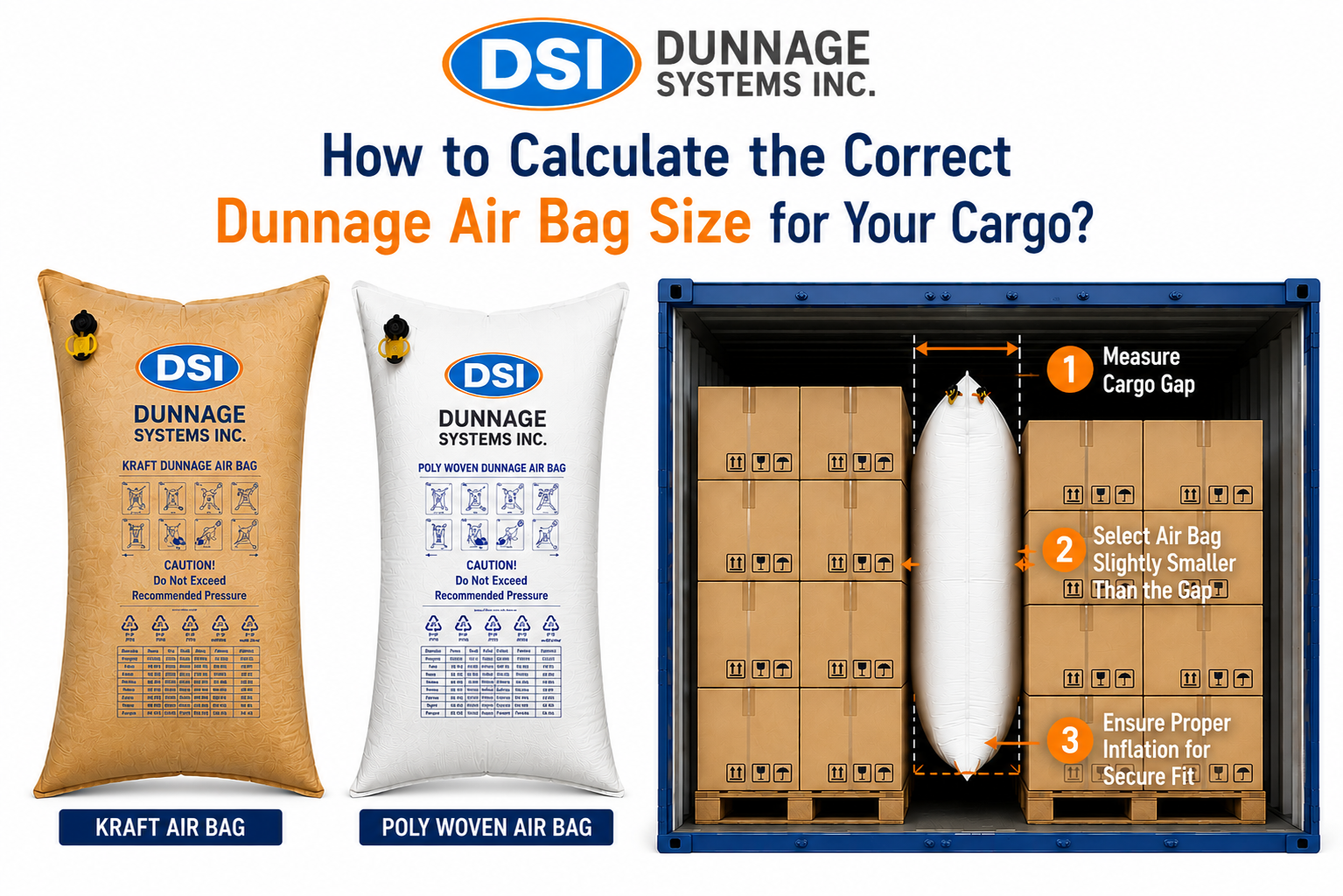
Before you place any order, you need three measurements from the actual load configuration you are working with. These measurements determine both the bag size and how many bags you need per void. Take them with the cargo loaded and in its final position inside the vehicle.
Step 1: Measure the Void Width
The void width is the horizontal gap between two adjacent cargo units, or between cargo and the trailer wall, door, or bulkhead. This is your most critical measurement because it directly determines the width of the bag you need.
Measure the gap at its widest point. Voids are not always uniform from top to bottom, and you need to size for the widest measurement to ensure the bag makes full contact across the entire gap.
Here is the standard void-to-bag-width matching guide used across the industry:
| Void Width (Gap Between Cargo) | Recommended Bag Width |
| Up to 8 inches | 24-inch wide bag |
| Up to 12 inches | 36-inch wide bag |
| Up to 14 inches | 48-inch wide bag |
| Over 24 inches | Use additional void fill support alongside the bag |
One important note: the void width measurement is taken on the actual inflated gap between cargo, not the deflated bag dimensions. A common mistake is measuring the bag itself rather than the space it needs to fill. Always measure the void first.
Step 2: Measure the Height of the Load
The bag height should span as much of the vertical void as practical. The general rule is that the bag should cover at least two-thirds of the pallet or load height to provide effective lateral bracing. A bag that only covers the bottom third of a tall load is not protecting the upper portion where tipping and shifting typically begin.
Measure from the floor to the top of the load. For standard pallet heights in a truck trailer, a 48-inch tall bag typically provides adequate coverage. For taller loads or double-stacked freight, you may need a taller bag or two bags stacked vertically in the same void.
For container air bags used in ocean shipping where cargo is stacked higher than a standard truck pallet, measure the full stack height and choose accordingly. A bag that covers the full height of the load always performs better than one that leaves the upper portion unsupported.
Step 3: Measure the Length of the Gap
The length measurement tells you how long the bag needs to be to span the full depth of the void from the front face of one cargo unit to the front face of the adjacent one, or from the cargo face to the trailer wall.
Standard pallet depth in a North American truck trailer is typically 40 to 48 inches, so a bag length of 48 to 60 inches covers most truck applications. For railcar and container applications, the pallet or crate depth may differ and the bag length should be selected to match.
The bag does not need to perfectly match the pallet length. It needs to span enough of the cargo face to distribute bracing force evenly across the load. A bag that is slightly longer than the pallet depth and folds slightly at the edges is fine. A bag that is significantly shorter leaves the edges of the load unbraced.
Step 4: Match Your Measurements to a Bag Size
Once you have your three measurements, void width, load height, and gap length, matching them to the right bag size is straightforward. Most manufacturers, including Dunnage Systems Inc., offer bags in standard size increments that cover the most common freight configurations.
Common standard sizes range from 24 x 36 inches on the smaller end up to 48 x 96 inches for larger void applications. For non-standard void dimensions that fall outside catalog sizes, custom sizing is available and is often the right call for operations with unusual load configurations or specialized containers.
If your measurements put you between two standard sizes, always size up. A slightly larger bag that fully covers the void will always outperform a slightly smaller bag that leaves gaps.
Other Factors That Affect Which Size Dunnage Air Bag You Need
The three measurements above give you the bag dimensions. But the right bag for your load is not just about physical size. These three additional factors affect which construction level and configuration you need alongside those dimensions.
Freight Mode: Truck, Rail, or Container
The forces a bag needs to absorb are different depending on how the freight is moving. Over-the-road truck shipments experience lateral forces from cornering and braking. Railcar applications involve significantly higher coupling and impact forces that require a higher-rated bag construction. Container air bags used in ocean shipping face longer transit times with continuous vibration and humidity exposure.
The freight mode determines the AAR level rating you need alongside the physical bag size:
- Truck: Level 1 to Level 2 polywoven or standard kraft paper bags work well for most over-the-road applications
- Intermodal: Level 2 to Level 4 polywoven for higher impact profiles and mixed lane conditions
- Rail: Level 3 to Level 5 polywoven with full AAR certification required for compliance
- Ocean container: Level 1 to Level 2 polywoven with moisture resistance as a priority consideration
Cargo Weight and Load Type
Heavier cargo puts more force on the bag when the vehicle decelerates, corners, or hits a bump. A void of 10 inches filled with steel components is a very different challenge than the same void filled with packaged consumer goods.
For heavy industrial cargo, automotive parts, machinery, metal coils, or similarly dense freight, step up to a higher ply kraft paper bag or a higher level polywoven bag even if the void size suggests a standard option. The bag needs to hold the load in position under real force, not just fill the space.
For lighter cargo like packaged food, consumer goods, or pharmaceuticals, a standard construction level matched to the void size is usually sufficient. The priority in these applications is often gentle, consistent contact pressure rather than maximum restraint force.
Single Bag vs Multiple Bags Per Void
Not every void needs a single bag. There are situations where using two bags in the same void is the right approach, and getting this decision right matters as much as the individual bag size selection.
Two bags stacked vertically in the same void make sense when the load height is significantly taller than any standard bag size and full-height coverage is needed. Two bags placed side by side in a wide void can be appropriate when the gap is larger than a single bag can effectively span, but the void is still within range for standard bag sizes.
For voids wider than 24 inches, a single bag is generally not enough. Voids that large should be reduced using additional void fill methods, honeycomb panels, or bulkheads, alongside the bag, not replaced by a larger single bag that cannot maintain proper contact pressure when fully inflated in an oversized space.
Common Sizing Mistakes and How to Avoid Them
These are the sizing errors that show up most often on the dock, usually after the order has already been placed.
Measuring the deflated bag instead of the void
The bag dimensions listed in a catalog refer to the bag when flat and deflated. What matters for sizing is the gap between your cargo, not the bag itself. Always measure the void first, then select the bag that matches it.
Ignoring load height coverage
A bag that only covers the bottom half of a tall load is not bracing the upper portion. Shifting and tipping typically start at the top, where the load has the most leverage. Make sure the bag height covers at least two-thirds of the pallet or load height.
Choosing size without considering freight mode
A bag sized correctly for a truck void may be the wrong construction level for the same void in a railcar application. Size and construction level are separate decisions that both need to be right. Always confirm the freight mode before finalizing the order.
Assuming one size works across all your lanes
Different lanes, different vehicles, and different cargo configurations can all require different bag sizes. Do not assume a bag that works on one lane will work on all of them. Re-measure when the load configuration changes.
Get the Right Size Dunnage Air Bags from Dunnage Systems Inc.
Dunnage Systems Inc. has been helping freight operations across the United States get the right cargo protection setup since 1992. That means over 30 years of sizing conversations, load consultations, and product recommendations across every freight mode and every industry imaginable.
They do not just sell bags. Before any order goes through, their team will work through your void dimensions, freight mode, cargo type, and route frequency to confirm the right bag size and construction level for your operation. If a standard size does not fit, custom sizing is available across both kraft paper and polywoven product lines.
Here is what you get when you work with Dunnage Systems Inc.:
- Free specification support before every order
- Kraft paper dunnage air bags in 2-ply through 8-ply constructions
- Polywoven dunnage air bags rated Level 0 through Level 5
- Custom sizing for non-standard void dimensions
- AAR certified products for full rail compliance
- Direct supplier pricing with no distributor markup
- Same-day quote response
- Delivery across all 50 states in pallet and truckload quantities
Call (870) 942-4830 or visit dunnagesystems.com to get a same-day quote and talk through your sizing requirements with their team.
Frequently Asked Questions
How do I measure the void for a dunnage air bag?
Measure the gap between cargo at its widest point to get the void width. Then measure the height of the load and the length of the cargo face. These three measurements together determine the correct bag size. Always measure the void itself, not the deflated bag.
What size dunnage air bag do I need for a 10-inch void?
A 10-inch void falls between the 8-inch and 12-inch standard sizing categories. The right call is a 36-inch wide bag, which is sized for voids up to 12 inches. When in doubt, size up to ensure full void coverage.
Can I use one dunnage air bag for a large void?
For voids wider than 24 inches, a single bag is generally not recommended. Large voids should be reduced using additional void fill methods like honeycomb panels or bulkheads alongside the bag, rather than relying on a single oversized bag that cannot generate adequate contact pressure.
Do container air bags need to be a different size than truck bags?
Not necessarily, but the void dimensions and load heights in shipping containers often differ from standard truck trailer configurations. Always measure the specific void in the container you are working with rather than assuming a bag that works in your truck will fit the container correctly.
Does cargo weight affect which dunnage air bag size I need?
Cargo weight affects the construction level and AAR rating you need more than the physical bag size. However, for very heavy loads, stepping up one size to increase the contact surface area can improve bracing effectiveness even when the void measurement would suggest a smaller bag.