
Most people think about cargo damage in terms of bags and bracing. The freight shifted, so the bag was probably the wrong size or the wrong level. That is sometimes true. But a significant portion of in-transit damage has nothing to do with the dunnage bag at all. It comes from voids in the load configuration that no bag was ever designed to fill, side gaps around individual pallet units, headspace above the load, lengthwise gaps from pallet underhang, and spaces between single units and the trailer wall.
That is the problem corrugated void fillers solve. They are not a substitute for dunnage bags. They address a different category of cargo movement, and when matched correctly to the load configuration, they eliminate the gaps that cause side shifting, forward creep, and load collapse that bags alone cannot prevent.
This guide covers every type of corrugated void filler system available from Dunnage Systems Inc., how each one works, and the four factors that determine which one is right for your shipment.
What Is a Corrugated Void Filler and Why Does It Matter?
Corrugated void fillers are structural freight protection panels made from corrugated paper and honeycomb materials. They are placed in the empty spaces within a loaded trailer, container, or railcar to prevent cargo from shifting during transit. Unlike dunnage air bags, which inflate to fill a void between cargo loads, corrugated void fillers are rigid or semi-rigid structural panels that physically block movement by occupying the space where cargo could shift.
The problem they solve is specific. A single pallet unit loaded in the center of a trailer has open space on both sides. A load of pallets with underhang has a gap between the bottom of the pallet and the trailer floor. A trailer with mixed cargo heights has headspace above shorter units. In all of these scenarios, dunnage air bags cannot help because there is no adjacent cargo load to brace against. The void filler fills that space structurally.
All corrugated void filler systems from Dunnage Systems Inc. are made from corrugated and honeycomb paper materials. They are fully recyclable, ship flat to minimize warehouse footprint, and are available in custom sizes for non-standard freight configurations. The right system depends on the direction of the void, the cargo type, the freight mode, and whether the product will be reused.
Types of Corrugated Void Filler Systems from Dunnage Systems Inc.
Dunnage Systems Inc. supplies seven industrial cargo void fill systems covering both structural and positional void fill applications. Here is what each one does and when it is the right choice.
Drop Down Void Fillers
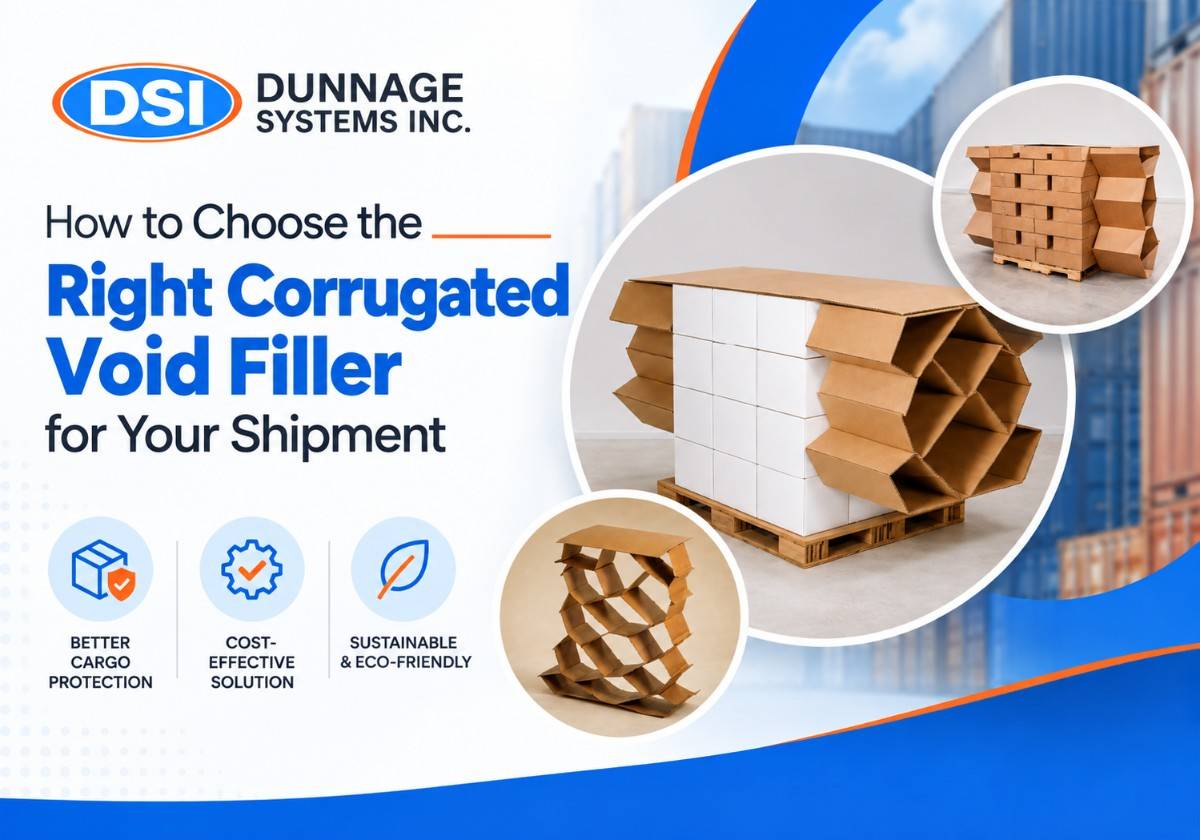
Drop down void fillers are designed to secure single pallet units from side shifting inside trailers and containers. The panel hangs from the trailer wall or cargo and drops down to fill the lateral gap between the load and the interior surface, blocking sideways movement without requiring adjacent cargo to brace against.
They are lightweight, fast to deploy, and ship flat to save warehouse space. For operations loading single units or mixed pallets where side shifting is the primary concern, drop down void fillers are the most direct solution. Drop length and filler width are customizable to match the specific gap dimensions of your trailer configuration.
Dual Drop Down Void Fillers
The dual drop down void filler addresses the same side shifting problem as the standard drop down, but from both sides simultaneously. Made from durable corrugated material, it prevents single units from shifting side to side and stops cargo from creeping toward the trailer sidewalls when loaded down the center of a transport vehicle.
This system is particularly effective for single pallet loads that sit in the middle of a trailer with open space on both sides. A standard drop down panel addresses one side. The dual configuration closes both gaps in a single deployment, which reduces setup time and ensures symmetrical lateral protection across the full load.
Honeycomb Void Filler Panels
Honeycomb void filler panels are the highest-strength option in the corrugated void filler range. The honeycomb cell design creates a lightweight structure with compression strength ranging from 10 to 69 PSI, making it capable of supporting extremely heavy freight loads while remaining a fraction of the weight of solid corrugated alternatives.
Their applications are broad:
- Buffer and tier sheets between stacked freight layers
- Filling headspace above cargo in boxcars, containers, and trailers
- Furniture protection and window and door securement
- Void fill in intermodal, ocean vessel, and over-the-road shipments
- Custom applications where high compression strength and light weight are both required
Honeycomb panels ship flat in high quantities per truckload, typically 20 to 50 times more panels per load compared to traditional foam or solid corrugated alternatives, which reduces inbound freight cost significantly on high-volume orders.
Corrugated Bulkhead Void Fillers
Corrugated bulkhead void fillers are used to prevent lengthwise load shift caused by pallet underhang. When a pallet does not fully extend to the trailer floor edge, the gap between the bottom of the pallet and the floor creates a space where the load can tip forward or slide during braking. The bulkhead filler closes that gap structurally.
These panels are foldable, self-supporting, and require no hangers or wall attachments to stand in position. They are also reusable across multiple shipment cycles, which brings the per-use cost down significantly on consistent freight lanes where the same trailer configuration repeats regularly.
Combined Void Filler and Dunnage Air Bag Systems
Some freight applications require both structural void filling and pneumatic bracing to achieve complete load securement. Combined systems integrate a corrugated void filler panel with a dunnage air bag in a single unit, providing structural support from the panel and inflation-based void filling from the bag simultaneously.
This one-piece design significantly reduces labor at the dock. Instead of placing a corrugated panel and then positioning and inflating a separate bag, the combined unit is placed once and inflated once. For operations dealing with large voids, heavy industrial cargo, or freight that requires both lateral and longitudinal protection, combining a void filler with a dunnage air bag in a single system is often the most efficient and reliable solution.
How to Choose the Right Corrugated Void Filler: 4 Key Factors
Getting the right void filler comes down to understanding your specific load configuration and what you are trying to prevent. These four factors will get you to the right product every time.
1. Direction of the Void
Start here. The direction the cargo can shift tells you which type of void filler you need.
- Side shifting (lateral movement): Drop down or dual drop down void fillers. These block the open space on the sides of single pallet units and prevent cargo from moving sideways during cornering, braking, or road vibration.
- Lengthwise shifting (forward or rearward movement): Corrugated bulkhead void fillers. These address pallet underhang gaps and prevent forward slide or tip under braking forces.
- Headspace (vertical void above the load): Honeycomb void filler panels. These fill the space above shorter cargo units in mixed-height loads, preventing tipping and providing tier support between stacked layers.
Many freight configurations have more than one direction of risk. A single center-loaded pallet in a trailer may have lateral risk on both sides and lengthwise risk from underhang at the same time. In those cases, a combined solution covering both directions delivers better protection than addressing only one.
2. Cargo Type and Weight
Lighter, fragile cargo like electronics, glass, and packaged consumer goods needs void fillers that provide gentle, consistent contact without applying excessive compressive force. Standard corrugated panels and lower compression honeycomb options work well here.
Heavy industrial cargo like machinery components, metal fabrications, and bulk materials requires a higher compression strength product. Honeycomb panels at the higher PSI ratings in the 40 to 69 PSI range are the right choice for heavy freight where the void filler needs to resist significant downward and lateral force without compressing or failing mid-transit.
When cargo weight pushes beyond what a corrugated panel alone can handle, a combined void filler and dunnage air bag system provides structural support from the panel and inflation pressure from the bag working together.
3. Freight Mode
Freight mode affects both the forces the void filler needs to handle and the environmental conditions it will be exposed to during transit.
For over-the-road truck freight, standard corrugated and honeycomb void fillers handle the lateral and longitudinal forces involved in road transport effectively. Drop down panels and bulkhead fillers are both well suited to truck applications.
For rail, intermodal, and ocean container freight, the higher forces involved in coupling, slack action, and continuous vessel motion may require a heavier-duty void filler option or a combined void filler and dunnage air bag system. Honeycomb panels at higher compression ratings handle the sustained forces in these modes better than lighter corrugated options.
Ocean container freight also introduces moisture exposure that affects corrugated material performance over long transit times. For very long transoceanic routes, discuss moisture resistance options with the Dunnage Systems Inc. team before selecting a void filler system.
4. Single Use vs Reusable
The right cargo void filler system for a single-use, high-volume operation looks different from the right system for a reusable, consistent-lane operation.
For operations where void fillers will be used once and either recycled or disposed of at the destination, the priority is the lowest cost per unit that still meets the performance requirement. Standard corrugated panels and honeycomb void fillers in single-use configurations are fully recyclable and cost-effective at scale.
For operations running consistent return lanes where void fillers can be recovered, inspected, and redeployed, the corrugated bulkhead and drop down panel options are designed for multiple use cycles. The per-use cost drops significantly on reusable systems when the bags are properly handled and stored between shipments, which makes the higher upfront cost per panel the more economical choice over a full quarter or year of operation.
When to Use Void Fillers Alongside Dunnage Air Bags
Corrugated void fillers and dunnage air bags are not competing solutions. They address different problems and often work best together.
A dunnage air bag fills the void between two adjacent cargo loads and braces them against lateral movement. A corrugated void filler fills the space around a single load unit where there is no adjacent cargo to brace against. When a trailer has both types of voids, both products are needed.
Combined void filler and dunnage air bag systems are designed specifically for situations where both structural support and pneumatic bracing are required in the same void. Heavy industrial cargo in a large void, for example, needs the corrugated panel to protect the cargo surface from direct bag contact and to distribute the inflation pressure evenly, while the inflated bag fills the remaining space and holds the panel firmly in position.
If your current cargo protection setup is using dunnage air bags only and still experiencing damage from side shifting or load collapse, adding the right corrugated void filler to your configuration is often the missing piece.
Get the Right Corrugated Void Filler System from Dunnage Systems Inc.
Dunnage Systems Inc. supplies a complete range of industrial cargo void fill systems for standard trailer configurations, bulk container loads, trailer load securement, and large-format freight applications across every major transport mode and industry. All products are made from corrugated and honeycomb paper materials that are fully recyclable and designed for reuse across multiple freight cycles.
Custom sizing is available across the full void filler product line for operations with non-standard freight configurations. Their team provides free specification support to confirm the right system for your cargo type, trailer setup, and freight mode before any order is placed.
Here is what you get when you order from Dunnage Systems Inc.:
- Seven industrial cargo void fill systems covering lateral, longitudinal, and headspace applications
- Drop down and dual drop down void fillers for single unit side shifting prevention
- Honeycomb panels with 10 to 69 PSI compression strength for heavy and light freight applications
- Corrugated bulkhead fillers for lengthwise load shift prevention
- Combined void filler and dunnage air bag systems for applications requiring both solutions
- Fully recyclable corrugated and honeycomb paper materials across all product types
- Custom sizing for non-standard freight configurations
- Free specification support to confirm the right system before you order
- Direct supplier pricing with no distributor markup
- Same-day quote response and delivery across all 50 states
Call (870) 942-4830 or visit dunnagesystems.com to get a same-day quote and talk through your void filler requirements with their team.
Frequently Asked Questions
What is a corrugated void filler and what does it do?
A corrugated void filler is a structural freight protection panel made from corrugated paper or honeycomb material. It fills the empty spaces in a trailer, container, or railcar around cargo loads to prevent shifting during transit. Unlike dunnage air bags, which inflate to fill voids between adjacent cargo loads, corrugated void fillers are rigid or semi-rigid panels that physically block movement by occupying the space where cargo could shift.
What is the difference between a drop down and a dual drop down void filler?
A drop down void filler fills the lateral gap on one side of a single pallet unit to prevent side shifting. A dual drop down void filler fills the lateral gaps on both sides simultaneously, which provides symmetrical protection for single units loaded in the center of a trailer with open space on both sides. The dual configuration is faster to deploy and ensures both sides are secured in a single placement.
When should I use a corrugated void filler instead of a dunnage air bag?
Use a corrugated void filler when the cargo movement risk is lateral side shifting of single units, lengthwise shift from pallet underhang, or headspace above mixed-height loads. These are situations where there is no adjacent cargo load for a dunnage air bag to brace against. For voids between two adjacent cargo loads, a dunnage air bag is the right tool. For many freight configurations, both products are needed and work best together.
Are corrugated void fillers reusable?
Yes. Corrugated bulkhead fillers and drop down panel systems are designed for multiple use cycles. They can be recovered at the destination, inspected, and redeployed on the return lane. Proper handling and flat storage between shipments extends the usable life significantly. For single-use, high-volume operations, all corrugated and honeycomb void filler materials from Dunnage Systems Inc. are fully recyclable.
Can I get custom-sized corrugated void fillers for a non-standard trailer configuration?Yes. Dunnage Systems Inc. offers custom sizing across the full void filler product line. If your trailer configuration, container type, or cargo dimensions fall outside standard product sizes, their team will work with you to spec the right dimensions before the order is placed. Custom sizing is confirmed at the time of quote with no premium lead time required for most applications.