
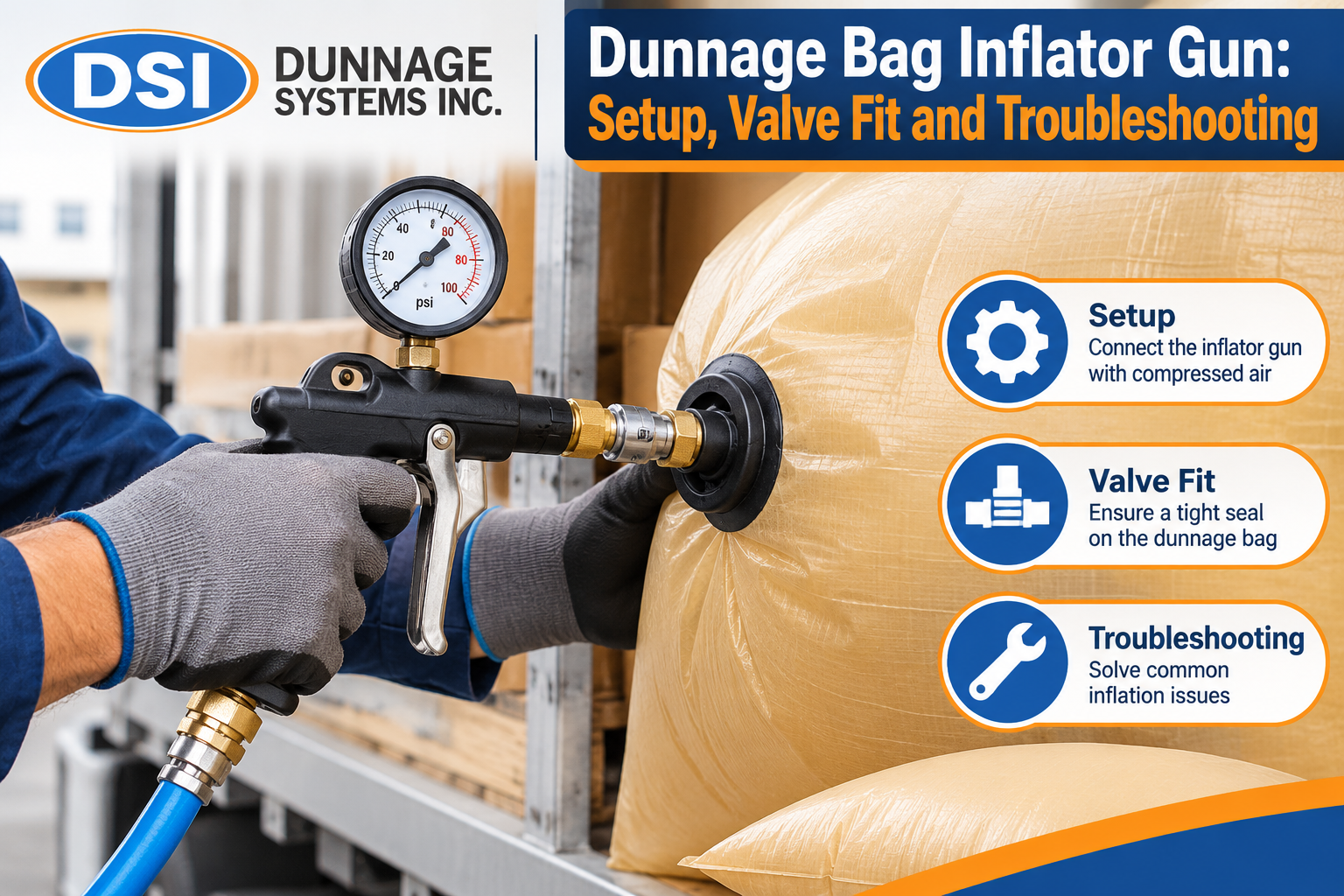
A dunnage bag inflator gun turns a slow, uneven job into a quick one. With the right setup, a loader can place and inflate a bag in under two minutes. When something is off, though, bags fill slowly, lose air or will not inflate at all, and the truck waits at the dock.
This guide covers how to set up a dunnage bag inflator, how to get a good seal on each valve type, and how to fix the most common problems.
Types of Dunnage Air Bag Inflators
Dunnage Systems offers two main types:
- Compressor-connected inflator guns. Trigger-operated guns that connect to your shop air supply with a standard quick-connect fitting. They include pressure monitoring. Standard and high-speed models are available, and high-speed models include a preset pressure regulator.
- Cordless, battery-operated inflators. Self-contained units with a built-in digital gauge. They need no external air source and are light enough for one-hand use, which makes them useful at docks without compressed air lines.
For a deeper comparison, read manual vs. cordless dunnage air bag inflators.
How to Set Up a Compressor-Connected Inflator Gun
- Check the air supply. Make sure the compressor is on and supplying air within a typical shop air pressure range. Follow the inflator’s operating instructions for the exact input.
- Inspect the hose and fittings. Look for cracks, kinks or worn couplers. Replace damaged parts before use.
- Connect the quick-connect fitting. Push until it locks, then tug gently to confirm it is seated.
- Check the gauge. Confirm the pressure gauge reads zero with the trigger released and responds when you test-fire away from people.
- Set the regulator if fitted. On high-speed models, confirm the preset regulator suits the bags you are using.
How to Set Up a Cordless Inflator
- Charge the battery before the shift. Dunnage Systems’ cordless models are designed to run through a standard loading shift without recharging.
- Turn on the unit and check that the digital gauge reads correctly.
- Keep a spare battery charged if your shift runs long or you use the inflator heavily.
Getting a Good Valve Fit
A poor seal between the nozzle and the valve is a common cause of slow inflation and lost air.
Kraft Bag Push-In Valves
Kraft dunnage bags use a valve and stem that the nozzle pushes into. Keep the stem straight. A kinked valve stem will not seal airtight. Insert the nozzle fully before pulling the trigger.
Polywoven Quick-Deflate Valves
Polywoven dunnage air bags use a quick-deflate removable valve. Make sure the valve is fully seated and closed before inflating, and that the nozzle is square to the valve.
Dunnage Systems’ compressor models work with both kraft push-in valves and polywoven quick-deflate valves without adapters. The cordless models are designed to fit standard dunnage bag valve types.
Inflating to the Right Pressure
Each bag has a maximum pressure. Exceeding it can burst the bag or damage cargo. On Dunnage Systems bags, maximum pressure ranges from 2 PSI on light-duty bags to 10 PSI on the heaviest grades. Check the rating for the bag in your hand.
Inflate gradually while watching the gauge, and stop when the bag fits firmly between both load faces. A correctly inflated bag compresses no more than half an inch under light palm pressure.
Dunnage Bag Inflator Troubleshooting
| Problem | Likely cause | What to do |
|---|---|---|
| Bag will not inflate | Air supply off, quick-connect not seated, nozzle not inserted, valve closed or blocked | Check compressor and coupler, reseat the nozzle, check the valve |
| Bag fills very slowly | Low supply pressure, long or narrow hose, partly blocked nozzle, standard model on large bags | Check supply pressure, shorten hose, clean nozzle, consider a high-speed model |
| Air escapes around the nozzle | Nozzle not square or fully inserted, worn nozzle seal | Reinsert squarely, replace worn parts |
| Bag loses air after inflation | Valve not fully closed, kinked kraft valve stem, puncture | Close the valve, straighten the stem, replace punctured bags |
| Gauge reading looks wrong | Damaged gauge or low battery on cordless units | Charge the battery, have the gauge checked or replaced |
| Bag over-inflates quickly | No regulator, trigger held too long | Inflate in short bursts and watch the gauge; consider a regulated model |
| Cordless unit stops mid-shift | Battery depleted | Swap in a charged battery; charge between shifts |
If a problem continues after these checks, stop using the inflator and contact your supplier.
Safety Tips for Inflator Guns
- Wear eye protection when using compressed air.
- Never point the nozzle at yourself or others.
- Disconnect the air supply before changing nozzles or doing maintenance.
- Never exceed the bag’s rated maximum pressure.
- Keep hands clear of the gap between loads while the bag inflates.
Caring for Your Inflator
- Wipe dust and debris off the nozzle after each shift.
- Store the gun off the floor and away from forklift traffic.
- Drain moisture from the compressed air line if your system allows it.
- Inspect hoses and couplers weekly.
Dunnage Systems’ pneumatic models use aluminum and polymer construction that resists impact, moisture and temperature changes, while high-speed industrial models use full metal construction. Good care keeps them performing longer.
Frequently Asked Questions
Why won’t my dunnage bag inflate?
Usually the air supply is off, the quick-connect is not seated, the nozzle is not fully in the valve, or the valve is closed. Check each one in that order.
Can one inflator gun work with kraft and polywoven bags?
Yes. Dunnage Systems’ compressor-connected inflators work with both kraft push-in valves and polywoven quick-deflate valves, without adapters.
How much pressure should I put in a dunnage bag?
Stay within the bag’s rated maximum, which ranges from 2 PSI to 10 PSI depending on the grade. Inflate until the bag fits firmly; it should compress no more than half an inch under light palm pressure.
Why is my dunnage bag losing air?
The most common causes are a valve that is not fully closed, a kinked kraft valve stem, or a puncture. Close or straighten the valve, and replace any damaged bag.
Do I need compressed air to inflate dunnage bags?
No. Cordless, battery-operated inflators need no external air source, which is useful at docks without air lines.
Keep Every Bag Filling Fast
A well set-up dunnage bag inflator gun saves time on every load. Check your air supply and fittings, get a square seal on the valve, inflate to the right pressure and use the troubleshooting table when something goes wrong.
Dunnage Systems supplies compressor-connected and cordless airbag inflators, plus kraft and polywoven bags. Contact our team for help choosing the right inflator, or read our dunnage bag inflator guide.