
Most conversations about dunnage bags focus on the bag itself. Which material, which size, which level. Those are the right questions to start with. But once you have the right bag, there is a second decision that matters just as much for how well your dock operation actually runs: which inflator are you using to fill it?
A bag that is underinflated does not fill the void properly and cannot generate the contact pressure needed to hold the load in place. A bag that is overinflated is at risk of failure under load, which means the cargo is exposed mid-transit. Both of those problems trace back to the inflator, not the bag, and both of them are avoidable with the right tool for the job.
This guide breaks down the two main types of dunnage airbag inflators, how each one works, which dock setup each is suited for, and how to make the right call for your specific operation.
Why the Right Dunnage Airbag Inflator Matters More Than You Think
Dunnage airbag inflators are not interchangeable accessories. They are the tool that determines whether the bag performs the way it was designed to. The bag and the inflator are a system, and when one part of that system is wrong for the application, the cargo protection suffers regardless of how good the bag itself is.
Overinflation is the most common mistake at the dock. A bag pushed beyond its design pressure cannot conform properly to the void, puts excess stress on the material, and can fail under the load forces generated during transit. Underinflation leaves gaps in the void and allows the cargo to shift. Both outcomes lead to damage claims that could have been prevented by using a calibrated inflator with proper pressure control.
Beyond pressure accuracy, the wrong inflator for a dock setup adds unnecessary time and friction to the loading process. An airline-connected inflator in a location without fixed compressed air means improvising with extension lines that create trip hazards and slow down the crew. A cordless inflator on a high-volume fixed dock means recharging batteries mid-shift when an airline gun would have kept pace without interruption.
Get the inflator right and the bag does its job every time. Get it wrong and the cargo is at risk even when the bag specification is perfect.
How Dunnage Airbag Inflators Work
All dunnage airbag inflators work on the same basic principle. The inflator nozzle connects to the bag valve, delivers controlled airflow into the inner bladder, and stops when the bag reaches its optimal inflation pressure. The bag expands to fill the void between cargo and generates the contact pressure needed to brace the load against lateral and longitudinal movement during transit.
All inflators from Dunnage Systems Inc. are compatible with both kraft paper dunnage bags and polywoven dunnage bags, with nozzle tips designed to latch securely into the standard valve used across both bag types. The key difference between inflator models is the air source they draw from and how they deliver that airflow to the bag.
Where inflators differ is in how they are powered and how portable they are. Airline-connected models draw from a fixed compressed air supply. Cordless models carry their own power source in the form of a rechargeable battery. Both can inflate a bag to the correct pressure. The question is which one does it in the right environment for your operation.
Airline-Connected Inflators: Built for High-Volume Fixed Dock Operations
Airline-connected inflators are the standard tool on high-volume loading docks where a fixed compressed air supply is already part of the infrastructure. They are lightweight, fast, and designed to deliver consistent airflow across a full shift without battery management or recharging downtime.
How Airline Inflators Work
The inflator connects to a compressed air supply via a standard airline fitting. When the nozzle is engaged with the bag valve, airflow is delivered directly into the inner bladder at a controlled rate. Most airline inflators include a built-in safety mechanism that vents excess air out of the rear of the gun once the bag reaches its optimal pressure, which prevents overinflation without requiring the operator to monitor a gauge actively.
Some models feature a venturi barrel that increases airflow speed compared to trigger-style designs, which reduces the time needed to inflate each bag. This is a meaningful operational gain on high-volume docks where the cumulative time difference across a full shift adds up to faster truck turnaround.
When Airline Inflators Are the Right Choice
Airline inflators are the right call when your dock has a fixed compressed air supply and your operation inflates a high volume of bags per shift from a consistent location. The continuous air supply means no downtime for recharging, no battery management between shifts, and consistent inflation speed from the first bag of the day to the last.
They work best for:
- Distribution centers and warehouses with permanent dock infrastructure and fixed air compressor systems
- High-volume operations inflating a large number of bags per shift from a fixed dock position
- Operations where the loading area is accessible and running an airline to the loading point is practical
- Environments where consistent inflation speed and uninterrupted operation across a full shift are the priority
The limitation of airline inflators is exactly what the name suggests. They require an airline. In locations without fixed compressed air, or in tight spaces like deep railcars and ocean containers where running a line is awkward and creates a trip hazard, the airline connection becomes a practical problem rather than an asset.
Cordless Dunnage Bag Inflators: Built for Flexibility and Remote Operations
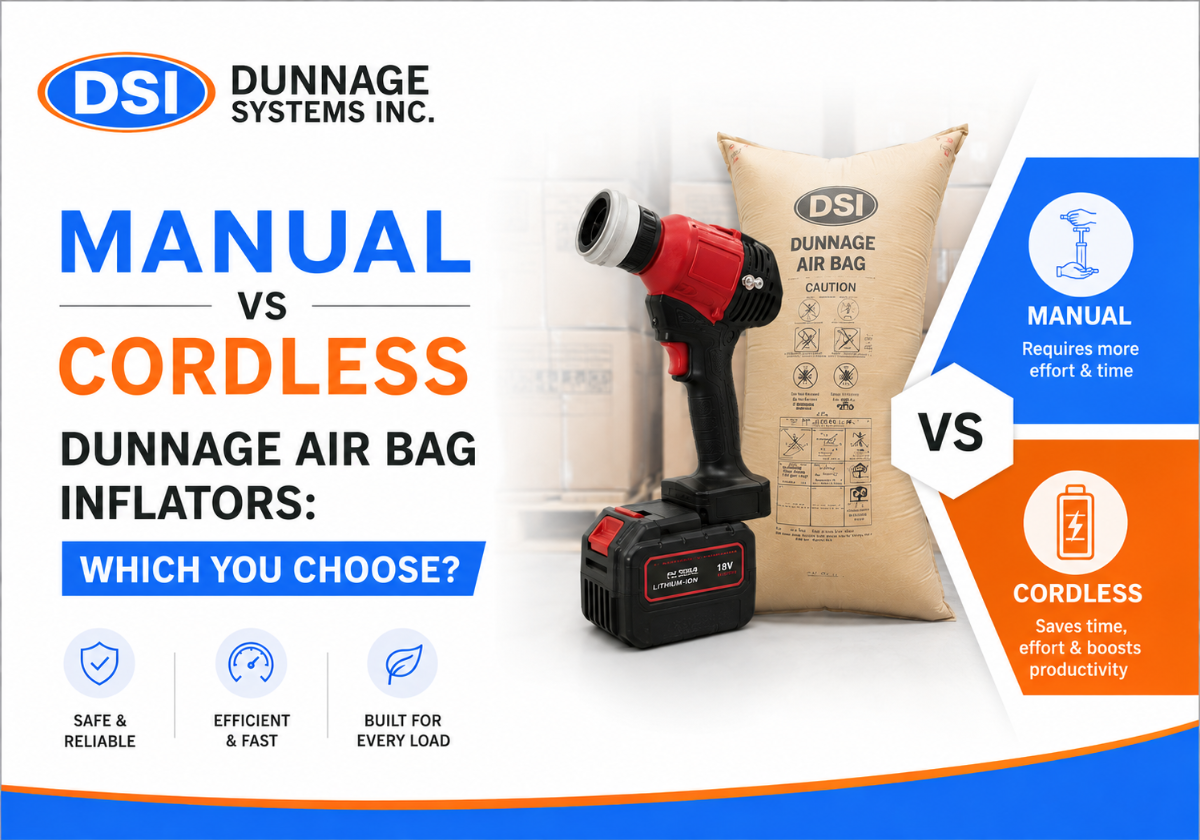
Cordless dunnage bag inflators are battery-powered tools that require no external air source. They deliver the same controlled airflow as an airline inflator but without the constraint of a fixed connection point. For operations that need to inflate bags in locations where an airline is impractical or unavailable, cordless is not just a convenience. It is the only option that works.
How Cordless Inflators Work
Cordless inflators run on rechargeable lithium-ion batteries, typically in the 18V to 21V range. The battery powers a motor that drives airflow through the nozzle and into the bag valve at a controlled rate. Higher-end models include a built-in digital pressure gauge that monitors inflation in real time and stops airflow automatically when the bag reaches its target pressure, eliminating the risk of overinflation without requiring the operator to watch a separate gauge.
The click-on head design on most cordless models allows for hands-free operation once the nozzle is engaged with the bag valve. The operator positions the inflator, clicks it into place, and the bag fills while they set up the next void. On a well-organized loading crew, this can meaningfully reduce the time per bag without sacrificing pressure accuracy.
When Cordless Inflators Are the Right Choice
Cordless inflators are the right call when portability and flexibility matter more than continuous high-volume output. They solve the specific problems that airline inflators create in certain environments.
They work best for:
- Field operations and remote loading sites without access to a fixed compressed air supply
- Ocean containers and deep railcars where running an airline to the loading point creates safety hazards or is physically impractical
- Operations that load freight at multiple locations or on the road where bringing a compressor is not feasible
- Smaller operations or start-ups that are not yet set up with fixed dock infrastructure but need a reliable inflation solution immediately
- Any situation where maneuverability in a tight space is more important than maximum inflation speed
The practical limitation of cordless inflators is battery life. On very high-volume docks inflating a large number of bags per shift, battery management becomes a real consideration. Having spare charged batteries on hand eliminates most of this concern, but it is still a factor that airline inflators do not require managing.
Side-by-Side Comparison: Airline vs Cordless Dunnage Airbag Inflators
| Feature | Airline-Connected Inflator | Cordless Inflator |
| Air Source | Fixed compressed air supply | Rechargeable battery, no air source needed |
| Portability | Limited by airline length | Fully portable, no tether |
| Inflation Speed | Fast, continuous output | Slightly slower, battery-dependent |
| Pressure Control | Built-in safety vent | Built-in digital gauge on advanced models |
| Best For | High-volume fixed dock operations | Field ops, containers, railcars, remote sites |
| Upfront Cost | Lower | Higher due to battery and motor |
| Ongoing Cost | Compressed air cost | Electricity for recharging only |
| Bag Compatibility | Kraft paper and polywoven | Kraft paper and polywoven |
4 Factors That Should Drive Your Inflator Decision
If you are still not sure which inflator type fits your operation after the comparison above, these four factors will get you to the right answer. Work through them in order.
1. Your Available Air Source
This is the most important question. If your dock has a fixed compressed air supply and the loading area is accessible from the airline connection point, an airline inflator is the practical choice. If you do not have fixed compressed air, or if the bags are being inflated in a location where running a line is impractical, a cordless inflator is the only viable option.
Do not try to work around the air source constraint by running very long airlines across a loading area. Long lines lose pressure over distance, create trip hazards, and slow the crew down. If the air source is not close to the loading point, use a cordless inflator.
2. Your Working Environment and Dock Setup
A standard truck trailer at a fixed dock with open access is the most forgiving loading environment. An airline inflator works well here because the dock worker can reach any part of the trailer without the airline becoming an obstacle.
A deep ocean container, a railcar, or a tight loading configuration where the bag void is far from the dock door is a different situation. Maneuvering an airline into position in a confined space is awkward and creates real safety concerns. A cordless inflator that the operator can carry to the exact position needed is significantly more practical in these environments.
3. Your Shipment Volume Per Shift
For operations inflating a very high number of bags per shift, continuous output matters. An airline inflator connected to a fixed compressed air supply does not have battery constraints and can maintain the same inflation speed from the first bag of the shift to the last without interruption.
For lower to moderate volume operations, or for operations where the total number of bags per shift is manageable within a full battery charge, a cordless inflator handles the volume without issue. The key is knowing your numbers before you decide. If your crew inflates far more bags per shift than a single battery charge can support without a spare on standby, factor that into the decision.
4. Bag Compatibility
Both inflator types are compatible with the full range of dunnage air bags supplied by Dunnage Systems Inc., including both kraft paper and polywoven constructions across all sizes and level ratings. The nozzle tips are designed to latch securely into the standard two-way spring valve used across the full product range, so bag compatibility is not a differentiating factor between inflator types.
What does matter is using a calibrated inflator rather than improvising with an uncalibrated air source. An uncalibrated air supply with no pressure control mechanism is the fastest route to overinflation and bag failure. Use a purpose-built inflator every time.
Get the Right Dunnage Airbag Inflator from Dunnage Systems Inc.
Dunnage Systems Inc. supplies both airline-connected and cordless dunnage airbag inflators to freight operations across the United States. Both models are compatible with the full range of kraft paper and polywoven dunnage bags they supply, and their team will confirm the right inflator for your dock setup, your volume, and your working environment before any order is placed.
With over 30 years of experience in cargo protection, they understand that the inflator and the bag are a system. Getting both right is what ensures the load is protected from dock departure to final delivery.
Here is what you get when you order from Dunnage Systems Inc.:
- Airline-connected dunnage airbag inflators for high-volume fixed dock operations
- Cordless battery-powered inflators for portable and remote loading applications
- Full compatibility with kraft paper and polywoven dunnage bags across all sizes and levels
- Free specification support to confirm the right inflator for your dock setup
- Direct supplier pricing with no distributor markup
- Same-day quote response
- Delivery across all 50 states
Call (870) 942-4830 or visit dunnagesystems.com to get a same-day quote and confirm the right inflator for your operation.
Frequently Asked Questions
Do I need a special inflator for dunnage air bags?
Yes. Dunnage air bags require a purpose-built inflator with a nozzle tip compatible with the bag valve and pressure control to prevent overinflation. Using an uncalibrated air source without pressure control is a common cause of bag failure and inconsistent cargo protection. Dunnage Systems Inc. supplies both airline-connected and cordless inflator models compatible with their full range of kraft paper and polywoven bags.
What is the difference between a manual and a cordless dunnage airbag inflator?
A manual or airline-connected inflator draws from a fixed compressed air supply via an airline connection. A cordless inflator is battery-powered and requires no external air source. Airline inflators are faster and better suited to high-volume fixed dock operations. Cordless inflators are more portable and better suited to field operations, ocean containers, railcars, and locations without fixed compressed air.
Can I use the same inflator for kraft paper and polywoven dunnage bags?
Yes. Both inflator types supplied by Dunnage Systems Inc. are compatible with kraft paper and polywoven dunnage bags across all sizes and level ratings. The nozzle tip is designed to latch securely into the standard two-way spring valve used across both bag types.
How long does it take to inflate a dunnage air bag?
With a properly matched inflator, most standard dunnage air bags inflate in under two minutes per void. Airline inflators with venturi barrels can fill bags faster than standard trigger-style inflators. Cordless inflators may take slightly longer depending on the battery charge level and motor output of the specific model.
What happens if I overinflate a dunnage air bag? Overinflation prevents the bag from conforming properly to the void shape, puts excess stress on the bag material, and can cause the bag to fail under the load forces generated during transit. Most purpose-built inflators include a safety mechanism, either a pressure vent or a digital gauge cutoff, that prevents overinflation automatically. This is one of the key reasons to use a calibrated inflator rather than an uncontrolled air source.