
You land on a product page for polywoven dunnage bags, and the first thing you see is a level rating. Level 1. Level 3. Level 5. The numbers are right there in the product name, but there is no explanation of what they actually mean for your load, your freight mode, or your operation. So you either guess, or you buy what you bought last time, or you call someone and hope they can explain it without turning it into a twenty-minute conversation.
This guide cuts through all of that. Level ratings on polywoven dunnage bags exist for a specific reason, and once you understand what they measure and how they map to real freight applications, picking the right one becomes a straightforward decision rather than a guessing game.
Here is everything you need to know about dunnage air bag levels, from what the rating system actually measures to which level fits which application, including a quick reference guide and the most common selection mistakes to avoid.
What Do Dunnage Air Bag Levels Actually Mean?
Polywoven dunnage bags are rated using a level system developed and administered by the Association of American Railroads. The AAR level rating, which runs from Level 0 through Level 5, indicates the amount of lateral load force a bag is certified to withstand during transit. A higher level means the bag is built to resist more force, handle heavier cargo, and perform in more demanding freight conditions.
The certification process involves standardized testing that every bag must pass before it can carry a level designation. Bags are tested for air retention over extended periods, burst pressure under load, and sustained performance under the kinds of forces that freight actually generates in transit. The level rating is not a marketing label. It is a performance threshold validated by independent testing.
It is also worth noting that while the AAR level system was developed with rail applications in mind, polywoven bags at all levels are used across truck, intermodal, and ocean container freight as well. The level rating tells you what force the bag can handle, and that information is useful regardless of the freight mode.
The short version: match the level to the force your freight generates. Lighter loads on standard truck routes need less. Heavier loads on rail or ocean routes need more. The sections below spell out exactly what each level covers.
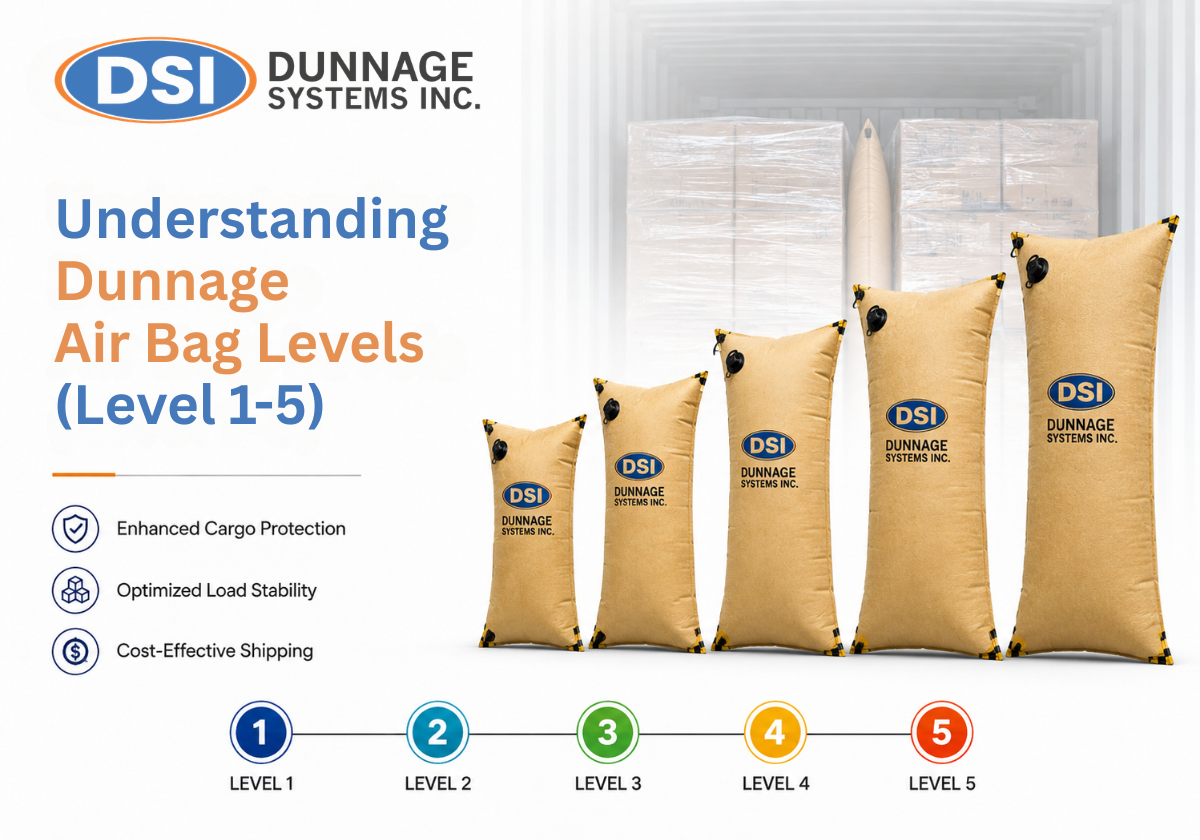
Dunnage Air Bag Levels Explained: Level 1 Through Level 5
Each level has a specific performance range and a set of freight applications it is built for. Here is what each one actually means in practical freight terms.
Level 1: Light Duty Truck and Intermodal Applications
Level 1 is the most widely used rating in over-the-road freight and the right starting point for most standard truck applications. It is designed for lateral void filling in truck and intermodal shipments with cargo loads up to approximately 44,000 lbs.
The forces a Level 1 bag needs to handle are lateral movement from cornering, forward movement from braking, and vertical vibration from road surfaces. These are significant forces, but they are well within the performance range that Level 1 construction provides for standard freight at standard truck weights.
Level 1 bags are the most cost-effective entry point into polywoven dunnage and a good fit for operations that are switching from kraft paper bags to a reusable option for the first time. For general cargo, packaged goods, food and beverage, consumer products, and similar freight on standard over-the-road lanes, Level 1 does the job reliably.
Level 2: Medium Duty Rail and Heavier Truck Applications
Level 2 steps up the performance rating for applications where the load is heavier than standard truck freight or where the freight mode introduces more demanding conditions. It bridges the gap between the everyday truck application that Level 1 covers and the high-impact rail environment where Level 3 and above become necessary.
In practice, Level 2 is commonly used for heavier over-the-road loads that push toward the upper end of standard truck weight limits, for intermodal containers that move across both truck and rail legs, and for lighter rail applications where the coupling and braking forces are moderate.
If you are running a truck operation with consistently heavy cargo and Level 1 bags have occasionally shown signs of stress under load, Level 2 is the right next step. The construction is more robust and the performance threshold is meaningfully higher without jumping all the way to rail-grade specifications.
Level 3: Heavy Duty Rail Applications
Level 3 is where rail-specific performance begins in earnest. It is the standard choice for most heavy-duty railcar applications and is built to handle the slack action, coupling impacts, and sustained braking forces that make rail transit the most demanding freight mode for load securement products.
Slack action is the key force to understand here. When a long freight train brakes or changes speed, the railcars do not all respond simultaneously. The resulting wave of compressive and tensile force that runs through the consist generates impact loads far higher than anything a road shipment produces. Level 3 construction is specifically engineered to absorb and resist those forces without failing mid-journey.
Level 3 bags are appropriate for railcar applications carrying moderate to heavy industrial cargo, including automotive components, manufactured goods, packaged chemicals, and similar freight categories where load security is a serious operational priority.
Level 4: Heavy Rail and Industrial Freight
Level 4 is built for very heavy industrial cargo in rail and intermodal applications where Level 3 is not sufficient. The cargo weight range it covers is significantly higher, and the construction reflects the additional force that heavier loads generate when the freight train brakes, couples, or changes speed.
Operations moving dense manufactured goods, heavy machinery components, steel fabrications, or other high-weight industrial freight by rail will typically find that Level 4 provides the right balance of performance and practicality. It handles the forces involved without requiring the maximum-duty construction that Level 5 carries.
Level 4 is also used in some ocean container applications where cargo weight is high and transit duration is long enough that sustained performance under load becomes as important as peak force resistance.
Level 5: Maximum Duty Heavy Rail and Ocean Freight
Level 5 is the heaviest-duty rating available in polywoven dunnage bags and is reserved for the most demanding load securement applications in the industry. It is designed for cargo loads that exceed what any lower level is built to handle, typically freight weighing above 200,000 lbs, and is primarily used in rail and ocean container applications.
The typical applications for Level 5 bags are heavy rail shipments of metal coils, brick, bulk paper rolls, and other extremely dense industrial materials where the sheer weight of the cargo creates load forces that lower-level bags cannot reliably contain. In ocean freight, Level 5 is used for particularly heavy containerized cargo on long transoceanic routes where sustained performance over weeks of continuous vessel motion is required.
There is no kraft paper equivalent to Level 5. The load forces involved exceed what paper construction can handle, which is why Level 5 exists only in polywoven form. If your freight profile puts you in Level 5 territory, polywoven is the only material option and the level selection is straightforward.
Quick Reference: Which Level Do You Need?
| Level | Freight Mode | Cargo Weight Range | Typical Application | AAR Certified |
| Level 1 | Truck, Intermodal | Up to 44,000 lbs | General freight, packaged goods, food and beverage | Yes |
| Level 2 | Truck, Rail (lighter), Intermodal | Up to 65,000 lbs | Heavier truck loads, lighter rail, mixed intermodal lanes | Yes |
| Level 3 | Rail, Intermodal | Up to 100,000 lbs | Standard heavy rail, automotive parts, industrial goods | Yes |
| Level 4 | Rail, Ocean | Up to 150,000 lbs | Heavy industrial rail, dense manufactured goods, long ocean routes | Yes |
| Level 5 | Rail, Ocean | Above 200,000 lbs | Metal coils, paper rolls, brick, maximum duty rail and ocean | Yes |
Common Level Selection Mistakes and How to Avoid Them
Level selection is where most dunnage bag buying mistakes happen, and almost all of them fall into one of three categories.
Going too low to save money on unit cost
A Level 1 bag costs less than a Level 3 bag. That is true. But a Level 1 bag in a rail application that generates Level 3 forces is not a saving, it is a liability. When an under-rated bag fails in transit, the cargo shifts, the damage claim follows, and the cost of the claim dwarfs whatever was saved on the bag purchase. Match the level to the actual freight mode and cargo weight before price enters the conversation.
Over-specifying and paying for performance you do not need
The opposite mistake is also real. An operation running standard over-the-road truck freight does not need Level 4 or Level 5 bags. The extra construction cost delivers no additional protection benefit in a freight mode that does not generate the forces those levels are built to resist. Match the spec to the application, not to the maximum available.
Ignoring freight mode and selecting based on cargo weight alone
Cargo weight matters, but freight mode matters more. A load that is perfectly fine with a Level 1 bag on a truck can require a Level 3 or higher on a rail leg of the same journey because the forces involved are fundamentally different. Always start with the freight mode, then confirm the cargo weight, then select the level. That order matters.
How Do Polywoven Dunnage Bag Levels Compare to Kraft Paper Ply Ratings?
If you have been buying kraft paper dunnage bags and are considering a switch to polywoven, you might be wondering how the two rating systems compare. They use different terminology, but there is a rough equivalency that helps frame the transition.
Kraft paper bags are rated by ply count, which measures the number of paper layers in the construction. Dunnage air bags in polywoven form are rated by AAR level, which measures certified load force resistance. The rough crossover looks like this:
- 2-ply kraft paper: Roughly equivalent to Level 1 polywoven for light truck applications
- 4-ply kraft paper: Roughly equivalent to Level 2 polywoven for medium-weight applications
- 6-ply to 8-ply kraft paper: Roughly equivalent to Level 3 to Level 4 polywoven for heavier applications
- No kraft paper equivalent exists for Level 5: Only polywoven construction can handle the forces at that rating
This crossover is a rough guide, not a direct specification equivalency. The construction materials and performance characteristics are different between kraft paper and polywoven, which is why polywoven bags consistently outperform kraft paper at equivalent ratings in moisture-exposed, heavy-duty, and reusable applications. Use this as a starting point for the conversation with your supplier, not as a final specification decision.
Get the Right Level Polywoven Dunnage Bags from Dunnage Systems Inc.
Dunnage Systems Inc. has been supplying polywoven dunnage bags and cargo protection products to freight operations across the United States since 1992. Their team will confirm the right level for your load, your freight mode, and your void dimensions before any order is placed, so you are not guessing at a product page and hoping for the best.
They supply polywoven dunnage bags from Level 0 through Level 5 in standard and custom sizes, with AAR certification documentation included for every rail-eligible product. Direct supplier pricing means no distributor markup, and same-day quote response means you are not waiting days for a number.
Here is what you get when you order from Dunnage Systems Inc.:
- Polywoven dunnage bags rated Level 0 through Level 5
- Standard and custom sizing for any void dimension
- AAR certified products with full compliance documentation for rail applications
- Free specification support to confirm the right level before you order
- Direct supplier pricing with no distributor markup
- Same-day quote response
- Delivery across all 50 states in pallet and truckload quantities
Call (870) 942-4830 or visit dunnagesystems.com to get a same-day quote and confirm the right level for your freight application.
Frequently Asked Questions
What do the levels mean on polywoven dunnage bags?
The level rating on polywoven dunnage bags is an AAR certification that indicates the lateral load force the bag is certified to withstand during transit. Level 1 is the lightest-duty rating, suitable for standard truck and intermodal applications. Level 5 is the heaviest-duty rating, designed for extreme load conditions in heavy rail and ocean freight. Higher levels are built for more demanding applications with heavier cargo and higher impact forces.
What level dunnage bag do I need for rail shipments?
Most standard heavy-duty rail applications require Level 3 as a minimum. Very heavy industrial cargo like metal coils, paper rolls, or brick typically requires Level 4 or Level 5. The specific level depends on the cargo weight and the forces generated by the rail route. Dunnage Systems Inc. provides free specification support to confirm the right level for your specific rail application before you order.
Is Level 1 enough for truck freight?
For most standard over-the-road truck applications with general cargo, packaged goods, food and beverage, or consumer products, Level 1 is sufficient. For heavier truck loads that approach upper weight limits, Level 2 provides additional capacity. The right level depends on your specific cargo weight and load configuration.
What is the difference between Level 3 and Level 5 dunnage bags?
Level 3 bags are built for standard heavy-duty rail applications with moderate to heavy industrial cargo loads. Level 5 bags are the maximum-duty rating in the polywoven system, designed for extremely heavy cargo like metal coils, paper rolls, and brick exceeding 200,000 lbs. Level 5 has no kraft paper equivalent and is used exclusively in the most demanding rail and ocean freight applications.
Do all polywoven dunnage bag levels require AAR certification?
Yes. All polywoven dunnage bags rated Level 1 through Level 5 carry AAR certification, which validates that the bag has passed standardized testing for air retention, burst pressure, and performance under load. AAR certification is mandatory for rail applications and is a strong quality indicator for any freight mode. Dunnage Systems Inc. provides full certification documentation with every rail-eligible order.