
If you have ever requested quotes from multiple dunnage airbag suppliers and wondered why the numbers looked so different, you are not alone. The same bag size can carry a dramatically different price tag depending on the material, the construction level, the order quantity, and where you are buying from. Without knowing what actually drives the price, it is easy to either overpay for specs you do not need or underpay for a bag that will not do the job.
The good news is that dunnage airbag pricing is not complicated once you understand the variables. Each factor has a logical reason behind it, and once you know what you are actually paying for, it becomes a lot easier to evaluate a quote, match the right product to your load, and make sure your operation is not spending more than it needs to on cargo protection.
This guide breaks down every factor that affects dunnage airbag pricing, what those factors mean in practical terms, and how to make sure you are getting the best value for your freight operation.
Why Dunnage Airbags Pricing Is Not One-Size-Fits-All
Unlike a commodity product with a fixed market price, dunnage airbags are manufactured in a wide range of materials, sizes, and construction levels, each designed for a different freight application. A 2-ply kraft paper bag for a light truck shipment and a Level 5 polywoven bag for heavy rail freight are both dunnage airbags. But they are built differently, perform differently, and cost differently for legitimate reasons.
Price variation between quotes also reflects where you are buying from. A distributor adds a markup layer on top of the manufacturer price. A direct supplier does not. Order volume matters too. A single pallet of bags carries a different per-unit cost than a truckload commitment.
Understanding these variables does not just help you evaluate quotes more accurately. It helps you avoid the two most common pricing mistakes: overpaying for a bag that is more than your load needs, and underpaying for a bag that is not enough for your freight mode.
Factors That Affect Dunnage Airbags Pricing
Six variables drive the majority of price differences you will see when comparing dunnage airbag quotes. Work through each one against your specific load requirements and you will have a clear picture of what you should be paying and why.
1. Material Type: Kraft Paper vs Polywoven
Material is the single biggest driver of unit price, and it is the first place to look when comparing quotes that seem far apart.
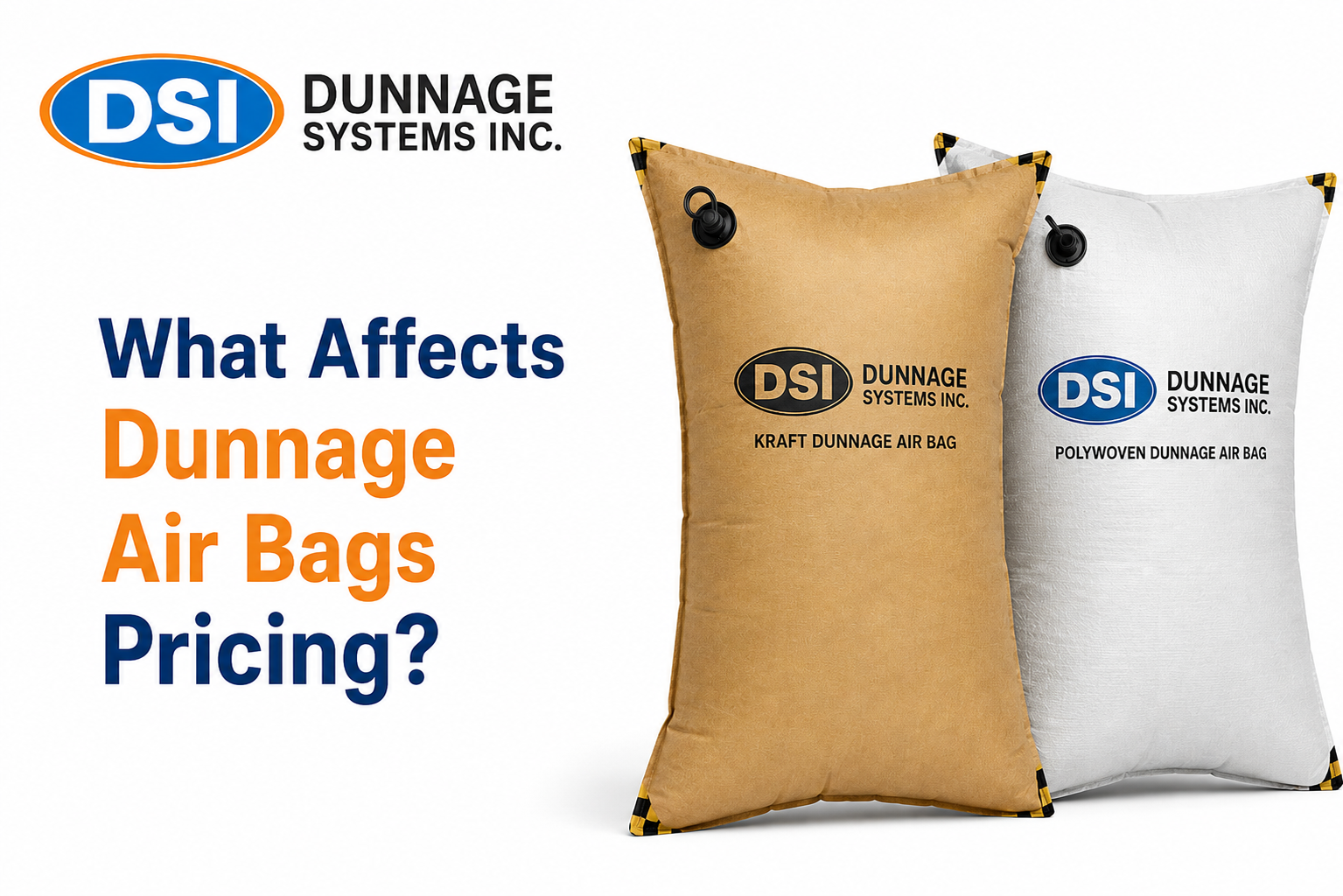
Kraft paper dunnage bags are manufactured from layers of high-strength extensible kraft paper with a polyethylene inner bladder. They cost less per unit because the raw materials are less expensive and the manufacturing process is simpler. They are the right choice for single-use, high-volume truck operations where keeping cost per shipment low is the priority. The trade-off is that they are not reusable and not the best fit for moisture-exposed or heavy-duty applications.
Polywoven dunnage bags cost more per unit because woven polypropylene fabric is more expensive to produce and the bags are engineered for significantly higher performance. They are moisture-resistant by construction, rated from Level 0 through Level 5, and designed to be deflated and reused across multiple shipment cycles. For operations running consistent lanes, the higher upfront cost pays back quickly through reuse savings.
If you are comparing a kraft paper quote to a polywoven quote and the polywoven is higher, that is not a pricing problem. That is an accurate reflection of the difference in materials and performance.
2. Bag Size and Void Dimensions
Larger bags use more material and cost more. That part is straightforward. A 24 x 36 inch bag will always cost less than a 48 x 96 inch bag of the same material and construction level, because the manufacturing input is simply greater for the larger option.
What matters for pricing is making sure you are not buying more bag than you need. Oversizing the bag to be safe does not improve performance. A bag that is significantly larger than the void it is filling cannot generate proper contact pressure, which means it is not doing its job as well as a correctly sized bag would. You end up paying more and getting less effective cargo protection.
Measure the void width, height, and length before selecting a size. Buy the bag that matches your void, not the next size up just to be safe.
3. Construction Level and Ply Rating
Within each material type, the construction level or ply rating is the next biggest price driver. Higher ply kraft paper bags and higher level polywoven bags both cost more because they use more material and are engineered to handle greater load forces.
For kraft paper bags, ply count runs from 2-ply for lighter loads up to 8-ply for heavy-duty applications. Each additional ply adds material cost and increases the price accordingly. For polywoven bags, the level rating runs from Level 0 through Level 5, with Level 5 being the heaviest-duty and most expensive option.
The right approach here is to match the level to what your load actually requires, not to buy the highest rating available. If your cargo and freight mode call for a Level 2 polywoven bag, buying a Level 4 does not make the load safer. It just costs more. Work with a supplier who will confirm the right level for your specific application before you order.
4. Order Volume and Quantity Breaks
Volume is one of the most impactful pricing levers available to a freight operation, and it is one that many buyers underutilize. Dunnage airbag pricing typically drops meaningfully as order quantity increases, with pallet quantities carrying a lower per-unit cost than case quantities, and truckload quantities carrying a lower per-unit cost than pallets.
The logic is simple from the supplier side. Larger orders reduce the per-unit cost of production setup, packaging, and shipping. Those savings get passed on to the buyer in the form of volume pricing. For operations with predictable usage, committing to a pallet or truckload order upfront is almost always the most cost-effective approach.
Volume pricing is also where buying direct from a manufacturer makes the biggest difference. A distributor adds a markup layer on top of the manufacturer price before passing the quote to you. That markup exists at every volume level. Buying direct removes it entirely, which means the volume savings go directly to your operation rather than being partially absorbed by a middleman.
5. AAR Certification Requirements
AAR-certified bags carry a slightly higher price than non-certified equivalents because the certification process involves standardized testing, documentation, and compliance validation that adds cost to the manufacturing process.
For rail applications, that cost difference is not optional. The Association of American Railroads requires AAR-certified load securement products in railcar applications. Using non-certified bags to save a few dollars per unit puts you at compliance risk and can void damage claims entirely if cargo is damaged and a carrier investigation finds non-certified products in the load.
For truck and ocean container applications, AAR certification is not a regulatory requirement, but it is still a reliable quality indicator. A bag that meets AAR testing standards has been validated against consistent performance benchmarks, which gives procurement teams a meaningful way to compare products across suppliers beyond just the unit price.
6. Custom Sizing vs Standard Catalog Sizes
Standard catalog sizes are manufactured at scale, which keeps the per-unit cost lower. Custom dimensions require dedicated production runs, which adds setup cost and typically results in a higher per-unit price, especially for smaller order quantities.
Custom sizing is necessary when your void dimensions fall outside standard catalog ranges, which happens more often than you might expect with specialized containers, unusual load configurations, or non-standard trailer types. In these cases, the right custom bag is worth the premium because a standard bag that does not properly fit the void will not protect the load effectively regardless of how cheap it was.
If a standard size covers your void dimensions, use it. If it does not, custom sizing is the right call and the price difference is justified by the performance benefit.
The Real Cost Comparison: Kraft Paper vs Polywoven Over Time
The upfront unit price comparison between kraft paper and polywoven bags is misleading on its own because it only captures one shipment. The more useful comparison is cost per use over time, and that math often looks very different from the sticker price.
A kraft paper bag is used once and recycled. Its cost per use equals its purchase price. A polywoven bag costs more to buy but can be reused across multiple shipment cycles. Divide the purchase price by the number of uses and the per-use cost drops with every additional cycle. For an operation running consistent lanes where bags can be recovered and returned, the polywoven bag becomes the more economical option relatively quickly.
The break-even point depends on your operation. For high-volume, varied-destination shipping where bag recovery is not practical, kraft paper remains the right economic choice. For consistent, repeat lanes where reuse is feasible, polywoven bags typically deliver a lower total cost of ownership within the first few months of switching.
Before comparing quotes on a per-unit basis, ask which bag type actually fits your operation. The cheaper bag per unit is not always the cheaper bag per shipment once you run the full numbers.
What Buyers Often Get Wrong About Dunnage Airbags Pricing
These are the three pricing mistakes that show up most often in freight operations, usually after the order has already been placed.
Choosing the cheapest bag without matching it to the load
A lower unit price on a bag that is not rated for your freight mode or load weight is not a saving. It is a risk. An under-rated bag that fails in transit means a damage claim, replacement product costs, and customer service time that far exceeds what a correctly specified bag would have cost. Price and specification are both part of the decision.
Buying through distributors when direct pricing is available
Distributor markup is real and it applies at every volume level. For operations buying in pallet or truckload quantities, buying direct from a manufacturer like Dunnage Systems Inc. can produce meaningful savings on every order. If you have never compared a direct supplier quote to your current distributor pricing, it is worth doing.
Over-specifying the level or ply and paying for performance you do not need
Buying a Level 5 polywoven bag for a standard over-the-road truck application that only requires Level 1 or Level 2 does not make the load safer. It just costs more. Match the specification to the actual requirement and you will free up budget without sacrificing protection.
How to Get the Best Price on Dunnage Airbags Without Sacrificing Performance
None of this requires a complicated procurement strategy. Four straightforward practices cover most of the opportunity.
- Buy direct from the manufacturer: Removes distributor markup entirely. For pallet and truckload quantities, the savings are significant and consistent across every reorder.
- Order in pallet or truckload quantities: Volume pricing kicks in at higher quantities. If your usage is predictable, committing to a larger order upfront almost always delivers a lower per-unit cost than repeated smaller orders.
- Match the spec to the load before ordering: Confirm the right material, ply or level, and size for your specific freight mode and void dimensions before placing any order. A supplier who provides free specification support before the sale is doing you a service that protects both your cargo and your budget.
- Ask for volume pricing upfront: Do not assume the first quote you receive reflects the best available price. Ask specifically about volume breaks, pallet pricing, and truckload rates. Most direct suppliers will provide tiered pricing on request.
Get a Same-Day Quote from Dunnage Systems Inc.
Dunnage Systems Inc. has been supplying kraft paper and polywoven dunnage airbags to freight operations across the United States since 1992. Buying direct means no distributor markup, transparent volume pricing, and a team that will confirm the right specification for your load before you commit to an order.
Their pricing is based on material type, construction level, bag size, and order volume, with no hidden fees and no surprises on reorders. Every bag ships to the same specification as the first order, and AAR certification documentation is included for every rail-eligible product.
Here is what you get when you order from Dunnage Systems Inc.:
- Kraft paper dunnage airbags in 2-ply through 8-ply constructions
- Polywoven dunnage airbags rated Level 0 through Level 5
- AAR certified products with full compliance documentation
- Custom sizing for non-standard void dimensions
- Free specification support to confirm the right bag before you order
- Direct supplier pricing with no distributor markup
- Transparent volume pricing confirmed at the time of quote
- Same-day quote response
- Delivery across all 50 states in pallet and truckload quantities
Call (870) 942-4830 or visit dunnagesystems.com to get a same-day quote with transparent, volume-based pricing for your specific bag requirements.
Frequently Asked Questions
What factors affect dunnage airbags pricing the most?
The six main factors are material type (kraft paper vs polywoven), bag size, construction level or ply rating, order volume, AAR certification requirements, and whether the bag is a standard catalog size or a custom dimension. Material type and order volume typically have the largest impact on per-unit price.
Why are polywoven dunnage bags more expensive than kraft paper bags?
Polywoven bags are manufactured from woven polypropylene fabric, which costs more to produce than kraft paper. They are also engineered for reuse across multiple shipment cycles, moisture resistance, and higher load ratings. The higher upfront cost reflects the higher performance and longer useful life of the product.
How does order volume affect dunnage airbag pricing?
Higher order volumes produce lower per-unit costs through volume pricing breaks. Pallet quantities carry a lower per-unit price than case quantities, and truckload quantities carry a lower per-unit price than pallets. For operations with predictable usage, committing to a larger order upfront is almost always the most cost-effective approach.
Is it cheaper to buy dunnage airbags direct from the manufacturer?
Yes. Buying direct from a manufacturer like Dunnage Systems Inc. removes the distributor markup that applies at every volume level. For pallet and truckload quantities, the per-unit savings from buying direct can be meaningful across the course of a full year of purchasing.
Do AAR certified dunnage airbags cost more than non-certified bags?
AAR-certified bags carry a slightly higher price than non-certified equivalents because the certification process involves standardized testing and compliance documentation. For rail applications, the cost difference is not optional. AAR certification is a regulatory requirement for load securement products in railcar applications, and the cost of non-compliance, including voided damage claims, far exceeds the certification premium.