
Here is a mistake that costs operations money more often than it should. Someone finds a cargo air bag that works well in their truck shipments and assumes it will do the same job in a railcar or an ocean container. The void size is similar. The cargo is the same. So the bag should work too, right?
Not quite. The forces that act on cargo in a truck trailer are fundamentally different from the forces in a railcar, which are different again from what happens inside a container on a vessel crossing the Pacific. A bag that performs perfectly in one mode can fail, underperform, or fall out of compliance in another, even if the void dimensions and cargo weight look identical on paper.
This guide breaks down what each freight mode actually demands from a cargo air bag and how to match the right bag type, material, and level to each one. Whether your freight moves by truck, rail, ocean container, or across multiple modes in a single journey, the right selection starts here.
Why Freight Mode Is the First Decision in Choosing Cargo Air Bags
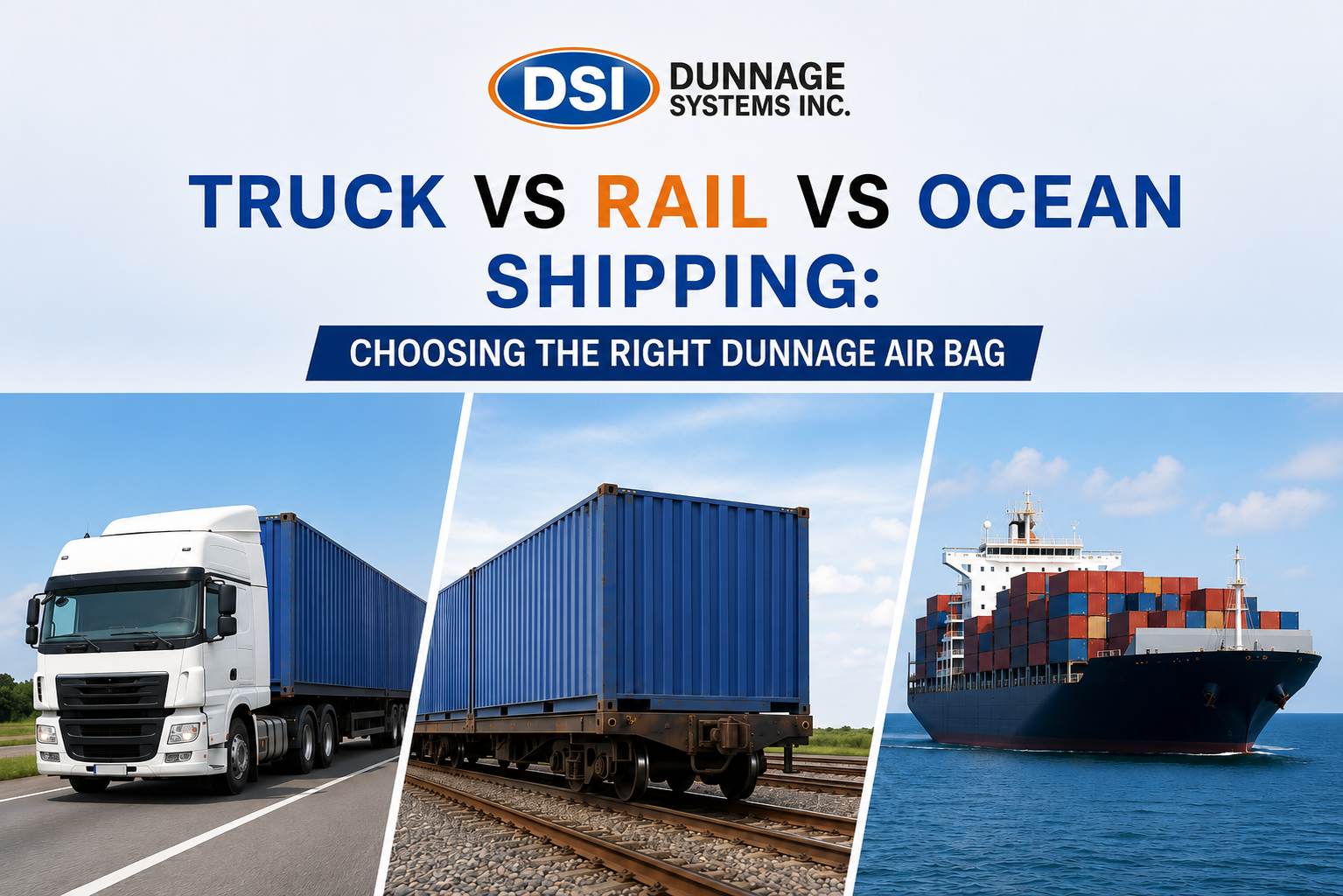
Every freight mode puts different physical forces on the load. A truck brakes hard and corners at speed, generating lateral and longitudinal forces that push cargo sideways and forward. A railcar experiences slack action, the sudden jolting force that happens when freight trains couple, brake, or change speed, which can generate impact forces far higher than anything a road shipment produces. An ocean vessel pitches and rolls continuously for days or weeks, exposing cargo to sustained multi-directional motion that neither truck nor rail freight encounters.
The bag you choose needs to handle the specific forces of the mode it is going into. That means the right material construction, the right AAR level rating, and in the case of rail, the right certification. Selecting based on void size alone, without considering the freight mode, is where most cargo protection mistakes begin.
Start with the mode. Then size the bag. That is the right order. Dunnage air bags from Dunnage Systems Inc. are available for all freight modes, and their team will help you confirm the right product before any order is placed.
Truck Shipping: What Your Cargo Air Bags Need to Handle
Over-the-road truck freight is the most common application for cargo air bags and also the most forgiving from a bag selection standpoint. The forces involved, lateral movement from cornering, forward movement from braking, and vertical vibration from road surfaces, are real and significant, but they are generally less severe than what rail or ocean freight produces.
That gives truck shippers the widest range of bag options to choose from, which is both an advantage and a source of confusion if you do not know what to look for.
Recommended Bag Type and Level for Truck Freight
For standard over-the-road applications, both kraft paper bags and polywoven bags work well. The decision between them comes down to whether the bags will be reused and what the cargo weight demands.
- Kraft paper bags (2-ply through 8-ply): The right call for single-use, high-volume truck operations where cost per shipment is the priority. Fully recyclable, fast to place, and effective for lighter to medium-weight cargo in dry conditions.
- Polywoven bags (Level 1 to Level 2): The better choice for heavier cargo, reusable programs on consistent lanes, or truck shipments where the load conditions are more demanding. Level 1 covers most standard truck applications. Level 2 provides additional bracing capacity for denser or heavier freight.
Key Considerations for Over-the-Road Applications
Truck freight gives you the most flexibility, but a few things still matter. Measure the void before selecting a bag size, not after. A bag that undersizes the void by a few inches will not generate adequate contact pressure on the cargo face, which means the load can still move.
For operations running high volume on consistent lanes, switching from single-use kraft paper to reusable polywoven bags can reduce per-shipment costs significantly over time. For varied-destination, high-volume operations where bag recovery is not practical, single-use kraft paper remains the most economical option.
Rail Shipping: Why the Requirements Are Stricter
Rail is the most demanding freight mode for cargo air bags, and the one where the wrong bag choice has the most serious consequences. The forces involved in rail transit are significantly higher than over-the-road, and the compliance requirements are more rigorous as a result.
Slack action is the key force to understand. When a long freight train brakes, couples with other cars, or changes speed, the railcars do not all respond simultaneously. The front of the train slows while the rear is still moving, creating a wave of sudden compressive and tensile forces that runs through the entire consist. These impact forces are far higher than anything generated by braking in a truck, and cargo air bags used in rail applications need to be rated to handle them.
AAR Certification Is Non-Negotiable
The Association of American Railroads mandates that load securement products used in railcar applications carry AAR certification. This is not a recommendation. It is a requirement, and using non-certified bags in a rail shipment creates two serious problems.
First, it puts you out of compliance with AAR Pamphlet 36, which governs dunnage requirements for boxcars and intermodal containers used in rail transport. Second, if cargo is damaged in transit and an investigation finds non-certified load securement products, the carrier can void the damage claim entirely. That means the full cost of the damaged freight falls on you.
Always ask for the certification documentation before purchasing cargo air bags for any rail application. A legitimate supplier will have it ready.
Recommended Bag Type and Level for Rail Freight
Polywoven bags are the standard for rail applications. Their elastic construction handles the high-impact forces of slack action better than kraft paper, which can fail under the sudden compressive loads that coupling and braking generate.
- Level 3 to Level 4: Suitable for most standard railcar applications with moderate to heavy cargo loads.
- Level 5: The heaviest-duty rating available. Required for extremely heavy cargo like metal coils, bricks, bulk paper rolls, or freight exceeding very high weight thresholds. Built for the most demanding rail conditions.
Kraft paper bags can be AAR certified for certain rail applications, but polywoven is the more reliable choice for rail given the higher forces involved and the need for consistent performance across a demanding transit environment.
Ocean Container Shipping: The Moisture and Duration Challenge
Ocean freight introduces two challenges that neither truck nor rail shipping creates to the same degree: prolonged moisture exposure and sustained multi-directional motion. A container on a vessel crossing the ocean is exposed to humidity, temperature swings between ports, and condensation on the interior container walls for days or weeks at a time. The vessel itself pitches, rolls, and yaws continuously, generating forces in multiple directions simultaneously.
Container air bags used in ocean freight need to hold up through all of it, from the moment the container is sealed at the origin port to the moment it is opened at the destination. That is a longer and more demanding duty cycle than any truck or rail journey.
Why Moisture Resistance Matters in Container Air Bags
Kraft paper bags are vulnerable in humid environments. The paper layers can absorb moisture and lose structural integrity before the shipment reaches its destination, especially on longer transoceanic routes where the container may spend two to four weeks in transit.
Polywoven bags do not have this problem. The woven polypropylene outer shell is inherently moisture resistant without requiring additional coating. It holds its shape and performance through temperature changes, humidity, and condensation exposure that would compromise a paper bag. For ocean freight, this is not a nice-to-have feature. It is a basic requirement for reliable cargo protection across the full transit.
Recommended Bag Type and Level for Ocean Freight
Polywoven bags are the clear choice for ocean container applications. The level selection depends on the cargo weight and the void dimensions inside the container.
- Level 1 to Level 2: Covers most standard ocean container applications with moderate cargo weights and typical void dimensions.
- Level 3 and above: Appropriate for heavier industrial cargo, long transit routes, or container loads where the vessel conditions are particularly demanding.
Reusable polywoven bags are a natural fit for ocean freight operations that use consistent container lanes. The bags can be deflated at the destination port, returned with the empty container, and reused on the next outbound load, which brings the per-shipment cost down significantly on high-frequency routes.
Intermodal Shipping: When Your Cargo Moves Across Multiple Modes
Intermodal freight is the most complex selection scenario because the cargo moves through more than one freight mode in a single journey. A container that starts on a truck, transfers to a rail leg, and finishes on an ocean vessel experiences the forces of all three modes before it reaches its destination.
The rule for intermodal is straightforward: select the bag rated for the most demanding mode in the journey, not the average. If any part of the route includes rail, the bag needs AAR certification and a level rating appropriate for rail forces. If the route includes ocean, the bag needs moisture resistance.
For most intermodal operations, polywoven bags at Level 2 to Level 4 cover the full range of conditions the load will encounter. They handle road vibration, rail impact forces, and ocean moisture in a single bag, which simplifies procurement and eliminates the need to manage different products across different legs of the journey.
Do not try to save money by selecting a bag rated for the easiest leg of the journey. A Level 1 bag that performs fine on a truck will not reliably survive a rail transfer with high slack action forces, and a failed bag mid-journey provides no protection for the rest of the route.
Side-by-Side Comparison: Cargo Air Bags by Freight Mode
| Feature | Truck | Rail | Ocean Container | Intermodal |
| Recommended Material | Kraft paper or polywoven | Polywoven only | Polywoven only | Polywoven only |
| Level Rating | Level 1 to Level 2 | Level 3 to Level 5 | Level 1 to Level 3 | Level 2 to Level 4 |
| AAR Certification Required | No | Yes, mandatory | No | Yes, if rail leg included |
| Moisture Resistance Needed | Optional | Optional | Yes, essential | Yes, essential |
| Single Use or Reusable | Either | Reusable preferred | Reusable preferred | Reusable preferred |
| Primary Force to Resist | Lateral, braking | Slack action, coupling impact | Rolling, pitching, vibration | All of the above |
Get the Right Dunnage Air Bag for Your Freight Mode from Dunnage Systems Inc.
Dunnage Systems Inc. has been supplying cargo air bags to freight operations across the United States since 1992. More than 30 years of working across truck, rail, ocean, and intermodal freight means their team understands exactly what each mode demands from a bag before a single recommendation is made.
They supply both kraft paper and polywoven dunnage air bags across all level ratings, with AAR certification documentation included for every rail-eligible product. Free specification support is available before every order, and their team responds to quote requests the same day. Whether your freight runs one mode or three, they will confirm the right bag before you commit to a purchase.
Here is what you get when you order from Dunnage Systems Inc.:
- Kraft paper dunnage air bags in 2-ply through 8-ply constructions for truck applications
- Polywoven dunnage air bags rated Level 0 through Level 5 for all freight modes
- AAR certified products with full compliance documentation for rail applications
- Custom sizing for non-standard void dimensions across any freight mode
- Free specification support and mode-matching advice before every order
- Direct supplier pricing with no distributor markup
- Same-day quote response
- Delivery across all 50 states in pallet and truckload quantities
Call (870) 942-4830 or visit dunnagesystems.com to get a same-day quote and confirm the right bag for your freight mode.
Frequently Asked Questions
Do I need different cargo air bags for different freight modes?
Yes. Truck, rail, and ocean shipping each generate different forces that require different bag constructions and level ratings. A bag suitable for truck freight may not meet the requirements for rail compliance or perform reliably in ocean container conditions. Always select based on the specific freight mode, not just the void size or cargo weight.
Are cargo air bags for rail shipments different from truck bags?
Yes. Rail applications require AAR-certified bags rated for the high-impact forces that slack action and coupling generate. Polywoven bags at Level 3 to Level 5 are standard for rail. Truck applications offer more flexibility, with both kraft paper and lower-level polywoven bags suitable for most over-the-road conditions.
What type of container air bags are best for ocean freight?
Polywoven bags are the standard for ocean container freight. Their inherent moisture resistance keeps them performing through the humidity, condensation, and temperature swings that sealed containers experience on long transoceanic routes. Kraft paper bags can lose structural integrity in sustained high-humidity conditions and are generally not the right choice for ocean applications.
What cargo air bags should I use for intermodal shipping?
Select based on the most demanding mode in the journey. If the route includes a rail leg, the bag needs AAR certification and a level rating appropriate for rail forces. If the route includes ocean, the bag needs moisture resistance. Polywoven bags at Level 2 to Level 4 cover most intermodal applications reliably across all legs of the journey.
Does Dunnage Systems Inc. supply cargo air bags for all freight modes?
Yes. Dunnage Systems Inc. supplies both kraft paper and polywoven dunnage air bags suitable for truck, rail, ocean, and intermodal freight. All rail-eligible products carry AAR certification with full documentation included. Their team provides free specification support to confirm the right bag for your specific freight mode before any order is placed. Call (870) 942-4830 or visit dunnagesystems.com for a same-day quote.