
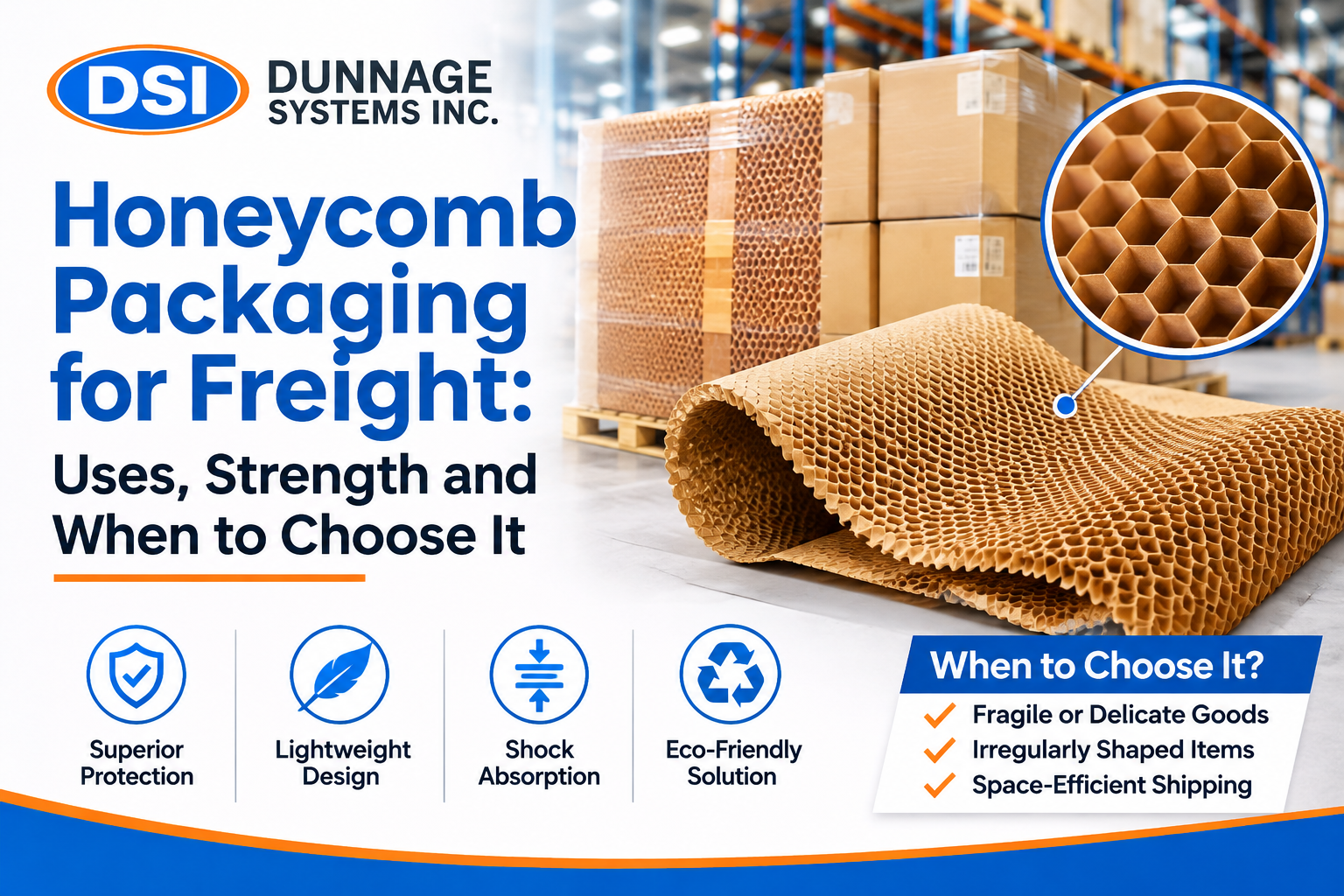
Many shippers are replacing foam, plastic fill and some wood blocking with paper-based honeycomb packaging. It is light, strong for its weight, and goes into paper recycling after use. But it is not the right answer for every void.
This guide explains what honeycomb packaging is and the main formats it comes in. It also covers how to choose cell size and thickness, and when honeycomb beats other void fill packaging.
What Is Honeycomb Packaging?
Honeycomb packaging is made from kraft paper formed into a pattern of six-sided cells, like a beehive. The cells are usually bonded between paper face sheets to make panels, pads or rolls.
The hexagonal structure gives honeycomb a high strength-to-weight ratio. When pressure is applied, the cell walls share the load, and when there is an impact, the cells crush in a controlled way and absorb energy.
Dunnage Systems’ honeycomb packaging is 100% recyclable, biodegradable and plastic-free, with no foam or chemical treatments. FSC-certified options are available on request.
Formats of Honeycomb Packaging
| Format | Typical use |
|---|---|
| Panels | Pallet tops and bottoms, load dividers, crate walls, void filling between stacks |
| Pads | Layer separation, cushioning under or between products |
| Rolls and wraps | Wrapping fragile items; works with standard dispensing systems |
| Die-cut inserts | Custom-shaped cradles for parts and fragile goods |
| Sheets and fill | Loose void fill inside boxes |
Honeycomb Void Filler for Freight
Honeycomb panels and blocks are widely used as void filler in freight. They fill spaces between pallet stacks, at the ends of loads and around irregular items. Because they are rigid, they can also serve as a lighter substitute for some wood components, such as dividers and spacers.
How to Choose Cell Size and Thickness
Two choices control how honeycomb performs:
- Cell size. Smaller cells mean more cell walls per area, which generally gives higher compression strength and a firmer surface. Larger cells are lighter and give more cushioning. Dunnage Systems’ standard cell sizes are 6 mm, 8 mm and 10 mm, with custom sizes available.
- Thickness. Thicker honeycomb absorbs more energy and spans larger voids. Standard thickness runs from 3 mm to 50 mm, depending on format.
Compression strength ranges from low to high depending on cell size and the number of layers. For heavy loads or stacking, ask for a recommendation based on your product weight and load pattern.
Roll formats come in standard widths of 500, 800, 1,000 and 1,200 mm, with custom sizes available on all formats.
Honeycomb vs. Other Void Fill Packaging
| Option | Strengths | Limits |
|---|---|---|
| Honeycomb packaging | Rigid, strong for its weight, recyclable, can be cut to shape | Paper can weaken if it gets wet; less flexible than airbags in changing gaps |
| Dunnage airbags | Fast to install, adjust to the gap, ideal between full pallet loads | Not for small gaps inside boxes; need correct inflation |
| Foam | Good cushioning, moisture-resistant | Often not recyclable curbside; bulky to store |
| Wood blocking | Very strong, familiar | Heavy, slower to install, may need heat treatment for export |
When to Choose Honeycomb
Choose honeycomb when you need rigid, shaped protection: at the edges or ends of a load, inside crates and boxes, or as dividers and layer pads. It suits shippers moving away from foam and plastic.
When to Choose Dunnage Airbags
Choose dunnage air bags for gaps between complete pallet loads in trailers, containers and railcars. Airbags conform to the gap and lock the load against the walls quickly. Many loads use both: airbags between pallets and honeycomb at the ends or inside packaging.
For other options, see our void fillers guide and how to choose the right corrugated void filler.
Using Honeycomb Inside Boxes
For box-level protection, a few simple rules help:
- Wrap or pad fragile products under about 5 lb before boxing.
- Fill voids so that no gap larger than about one inch remains.
- Close the box and shake it. Repeat until the product does not move.
Sustainability Benefits
Honeycomb packaging helps shippers reduce plastic. It is paper-based, recyclable with standard paper recycling, and contains no foam. FSC-certified material is available for shippers with responsible-sourcing targets. Because it is light, it adds little to shipment weight.
Limits to Keep in Mind
- Moisture. Like other paper products, honeycomb can lose strength if it gets wet. Test it for your humidity conditions before switching, especially for ocean freight.
- Validation. Check stacking and compression performance on your actual load before rolling it out.
Frequently Asked Questions
What is honeycomb packaging made of?
It is made from kraft paper formed into hexagonal cells, usually bonded between paper face sheets. Dunnage Systems’ honeycomb is plastic-free and contains no foam or chemical treatments.
Is honeycomb packaging recyclable?
Yes. Dunnage Systems’ honeycomb packaging is 100% recyclable and biodegradable. FSC-certified options are available on request.
Is honeycomb packaging strong enough for heavy loads?
It can be. Strength depends on cell size, thickness and the number of layers. Smaller cells and more layers generally give higher compression strength. Confirm performance on your actual load.
Can honeycomb replace dunnage airbags?
Not always. Honeycomb is best for rigid, shaped protection and smaller voids. Dunnage airbags are faster and more adaptable for gaps between full pallet loads. Many shippers use both.
What cell size should I choose?
Smaller cells, such as 6 mm, generally give a firmer, stronger surface. Larger cells, such as 10 mm, generally give more cushioning at a lighter weight. Ask for a recommendation for your product.
Choose the Right Honeycomb for Your Load
Honeycomb packaging gives shippers a strong, light and recyclable way to protect products and fill voids. Pick the cell size and thickness for your load, use it where rigid protection matters, and pair it with dunnage airbags for gaps between pallets.
Dunnage Systems supplies honeycomb panels, pads, rolls and custom inserts in pallet and truckload quantities. Request a quote or explore our honeycomb packaging.