
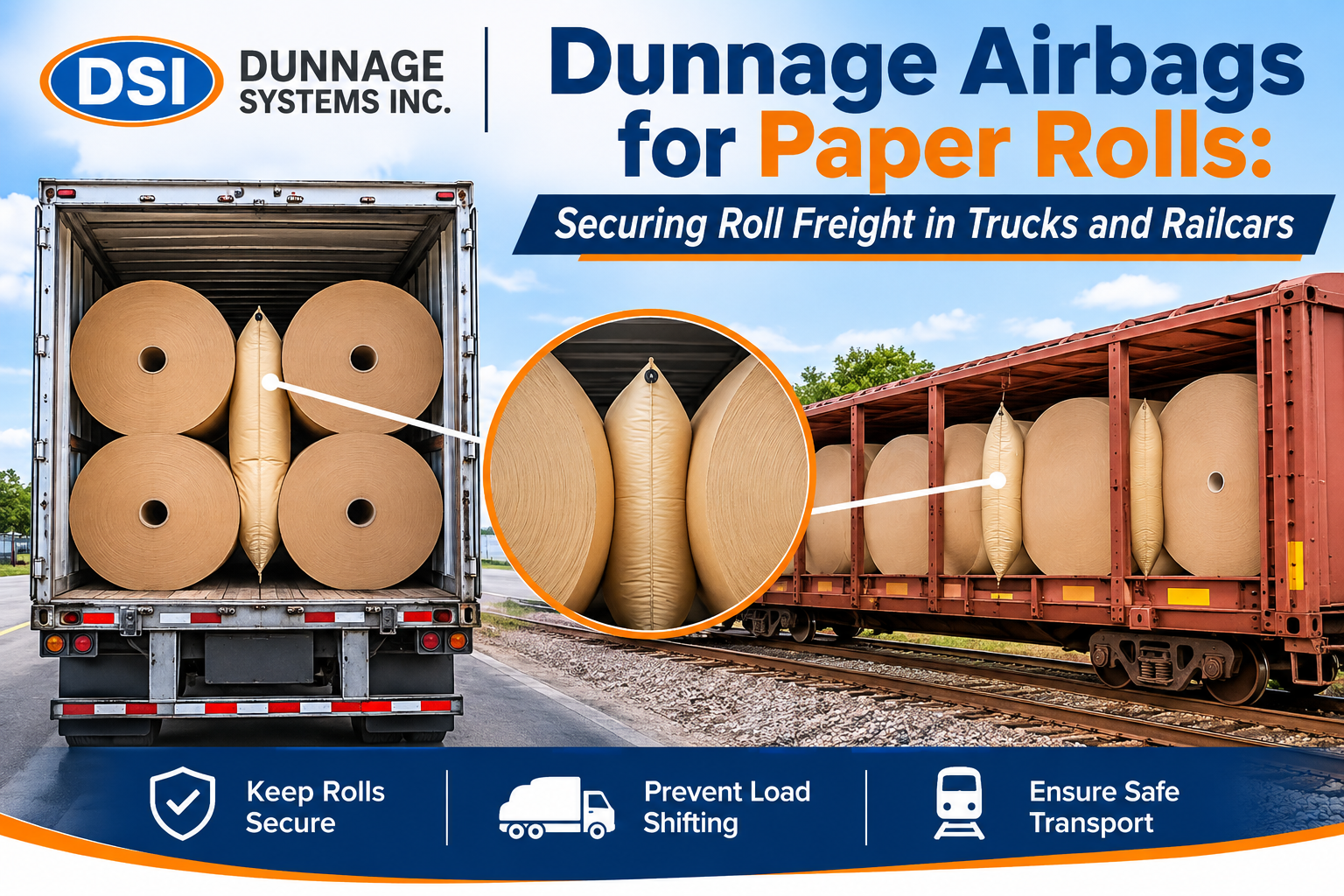
Paper rolls are heavy, round and easy to damage. A roll that shifts even a few inches can crush its edges, go out of round or tip over, and a damaged roll may be rejected by the customer. Dunnage airbags for paper rolls fill the gaps between rolls so they stay tight against each other and the vehicle walls for the whole trip.
This guide covers the federal truck rules for paper rolls, how rolls are commonly secured in railcars, and how to choose and place industrial dunnage bags for roll freight.
Why Paper Rolls Are Hard to Secure
Paper rolls create three problems that most palletized freight does not:
- They are round. Rolls loaded on their sides can roll, and rolls standing on end can tip.
- They are dense. A single roll can weigh several tons, so the forces in braking or rail switching are large.
- They damage easily. Edges and outer wraps crush or tear when rolls hit each other or the vehicle.
Rigid blocking can hold rolls in place, but it does not conform to curved surfaces. An inflated dunnage bag spreads its pressure across the curved face of the roll, which helps hold the roll without creating hard contact points.
FMCSA Rules for Paper Rolls on Trucks
Paper rolls have their own commodity-specific rule in the federal cargo securement regulations, 49 CFR 393.122.
When the Paper Roll Rule Applies
The rule applies to shipments of paper rolls that, individually or together, weigh 5,000 lb (2,268 kg) or more. Lighter shipments, and rolls that are unitized on a pallet, may be secured either under this rule or under the general cargo securement rules.
Key Requirements in Sided Vehicles
For rolls carried with eyes vertical (standing on end) in a sided vehicle such as a dry van:
- Rolls must be placed tightly against the vehicle walls, other rolls or other cargo to prevent movement.
- A roll that could tip forward must be prevented from tipping, for example by banding it to other rolls, bracing or tiedowns.
- If a friction mat provides the main securement for a roll, the mat must stick out from under the roll in the direction it is securing.
FMCSA’s cargo securement guidance for stacked roll loads lists void fillers such as honeycomb, blocking, bracing, friction mats and tiedowns as methods. Dunnage bags fill the remaining spaces so rolls stay tight against each other and the walls, as the rule requires.
Flatbeds and Curtain-Siders
On flatbeds and curtain-sided vehicles, rolls must also be secured with tiedowns under the general rules. Stacked loads of rolls with eyes vertical are prohibited on these vehicles.
For tips that apply to all freight, see our guide to load securement tips and our range of load securement products.
Paper Rolls in Railcars
Much paper moves by rail in boxcars. Railroad loading rules, based on the Association of American Railroads (AAR) guidance, often specify how rolls must be loaded and which bags can be used. A common practice is to place dunnage airbags in the central void between rows of rolls, so the load is pushed outward against the car walls.
Rail impacts during coupling and switching are severe, so rail roll loads need high-strength bags. Dunnage Systems lists paper rolls as a Level 5 application for its polywoven bags, and supplies AAR compliance documentation for Levels 3 to 5. Read more in why rail shipments require AAR-verified dunnage airbags.
Choosing Dunnage Airbags for Paper Rolls
| Situation | Typical bag choice |
|---|---|
| Light roll loads by truck | Kraft 2-ply or 4-ply, or polywoven Level 1 or 2 |
| Heavy roll loads by truck or ocean | Kraft 4-ply or polywoven Level 2 to 3 |
| Rail and heavy intermodal roll loads | Polywoven Level 4 or 5, or kraft 6-ply or 8-ply |
| Heaviest rail roll loads | Polywoven Level 5 |
These are starting points. The final choice depends on the load weight, the void size and any loading figure that applies. See polywoven dunnage air bags and kraft dunnage air bags for ratings, and our levels guide for the full scale.
How to Place Dunnage Bags Between Paper Rolls
- Load rolls tightly. Keep rolls in contact with each other and the walls wherever possible, so voids are small.
- Add friction mats. Anti-slip rubber mats under rolls reduce sliding. Make sure the mat sticks out in the direction it is securing.
- Measure the remaining voids. See our guide on how to calculate dunnage air bag size.
- Protect the bag. Where roll edges, cores or banding could cut the bag, place a smooth protective sheet between bag and roll.
- Inflate to the right pressure. Use an airbag inflator with a gauge and stay within the bag’s rated maximum.
- Check the fit. The bag should press firmly against both faces without distorting the rolls.
Common Mistakes With Roll Freight
- Using a light truck-grade bag on rail. Rail impacts need higher levels.
- Over-inflating. Too much pressure can crush roll edges or distort cores.
- Leaving tipping risk unaddressed. Bags fill voids but do not replace banding or bracing for rolls that could tip.
- Placing friction mats wrong. A mat that does not stick out in the securing direction may not meet the rule.
Frequently Asked Questions
What level dunnage airbag is best for paper rolls?
For rail and the heaviest loads, Dunnage Systems lists polywoven Level 5 bags for paper rolls. Lighter truck loads can use lower levels or kraft bags. Always follow any loading figure that applies.
Do FMCSA rules allow dunnage bags for paper rolls?
Yes. The general rules accept dunnage bags as a way to secure cargo, and the paper roll rule requires rolls to be placed tightly against walls or other cargo. Dunnage bags help achieve that by filling the gaps.
When does the FMCSA paper roll rule apply?
It applies to paper roll shipments weighing 5,000 lb or more, individually or together. Lighter loads and palletized rolls may follow either the paper roll rule or the general rules.
Can dunnage bags stop paper rolls from tipping?
They help by keeping rolls tight, but rolls that could tip forward also need banding, bracing or tiedowns as the rule requires.
Are friction mats needed with dunnage airbags?
They are often used together. Friction mats reduce sliding, while dunnage bags fill voids. If a mat is the main securement for a roll, it must stick out from under the roll in the securing direction.
Protect Every Roll From Mill to Customer
Dunnage airbags for paper rolls help keep heavy, round freight tight and undamaged on trucks and railcars. Combine the right bag level with friction mats, correct inflation and any banding or bracing the rules require.
Dunnage Systems supplies industrial dunnage bags, friction mats and void fillers to the paper and pulp industry, with AAR documentation for rail-grade bags. Talk to our team about your roll loads, or explore our design services.