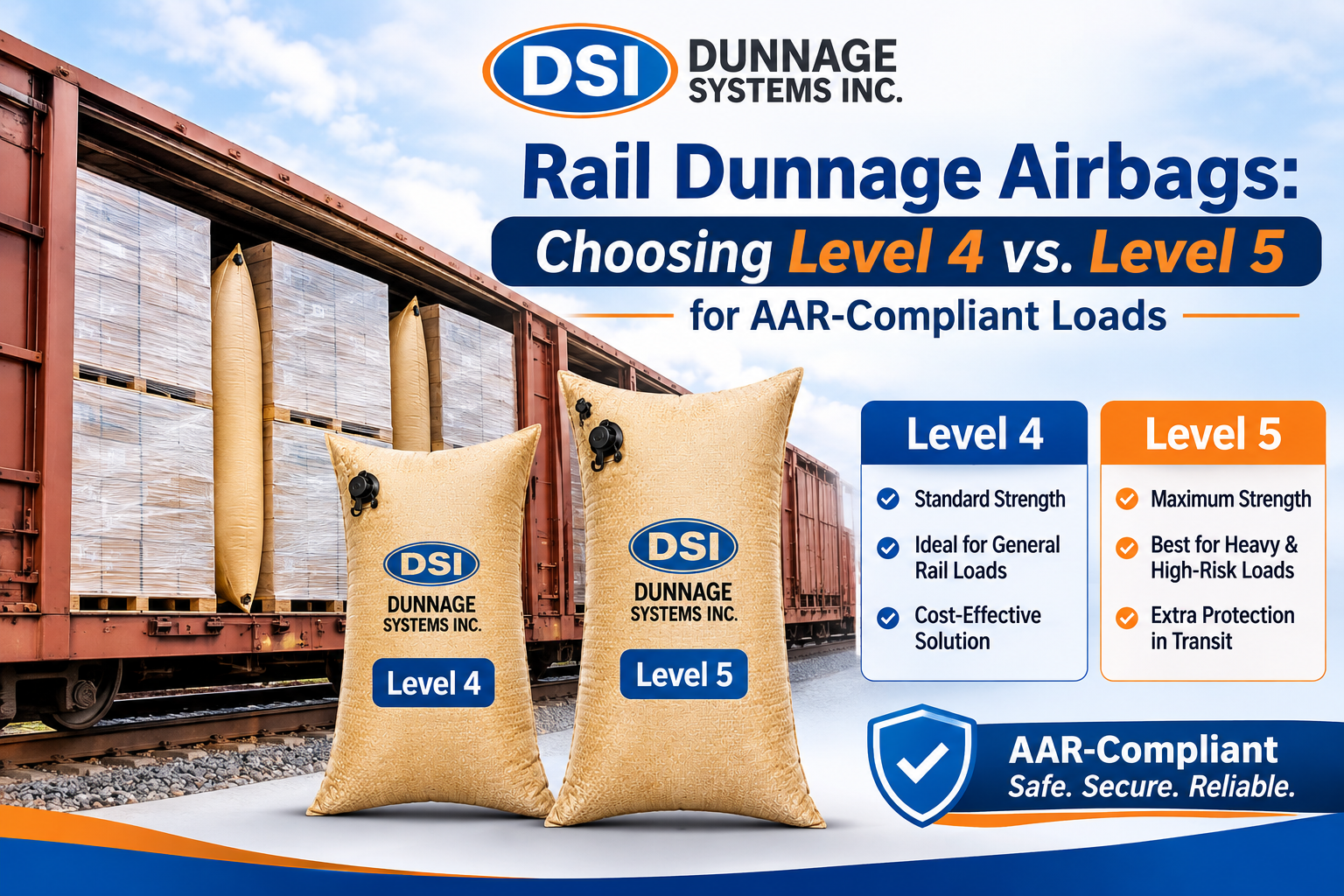
Rail freight takes harder hits than almost any other mode. Railcars are coupled, switched and humped in yards, and every impact pushes the load lengthwise inside the car. Rail dunnage airbags fill the voids that let cargo move, but only if the bag is strong enough for the load and approved for rail use.
For heavy rail freight, the choice usually comes down to Level 4 or Level 5. This guide explains how AAR levels work, how to choose between the two, and what loading rules require.
Why Rail Needs Stronger Dunnage Airbags
On the highway, the biggest forces come from braking and cornering. In rail, the biggest come from lengthwise impacts during coupling and switching, when cars meet at speed. A loose load in a boxcar can shift, damage itself, and damage the car.
Dunnage airbags fill the space between loads, or between the load and the car wall, so the cargo moves as one block. In rail, that block can be very heavy, which is why rail dunnage airbags come in higher strength levels than bags made for truck freight.
What “AAR Approved” Means
The Association of American Railroads (AAR) publishes the loading rules used by North American railroads. These include the Open Top Loading Rules and closed-car loading guidance approved by the AAR’s Damage Prevention and Freight Claim Committee.
For inflatable dunnage bags, the AAR uses a performance profile for pneumatic dunnage that tests bags at different levels. Tests check how well a bag holds air over time and how much pressure it can take before bursting. Bags that pass are approved at a given level. You may see both “AAR approved” and “AAR verified” used by suppliers to describe bags that have passed this process.
Approval matters most when the rules require it. Under the AAR’s open-top loading rules:
- Inflatable dunnage bags may be used only when a specific loading figure allows them.
- Bags used in open-top loading must be AAR approved.
- Bags may be used for one loading only and are not reusable.
For background, read why rail shipments require AAR-verified dunnage airbags.
Level 4 vs. Level 5 Dunnage Airbags
Higher levels are built for heavier cargo and harder service. Based on Dunnage Systems’ polywoven dunnage air bags specifications:
| Feature | Level 4 | Level 5 |
|---|---|---|
| Maximum pressure | 10 PSI | 10 PSI |
| Transport modes | Rail, intermodal, ocean | Rail, intermodal, ocean |
| Typical use | Heavy industrial rail freight | Maximum-duty rail and ocean freight |
| Example cargo | Heavy palletized industrial products | Paper rolls, metal coils, brick and similar dense loads |
| AAR documentation | Available | Available |
When to Choose Level 4 Dunnage Airbags
Level 4 suits heavy rail loads that do not reach the top of the weight range. It is a common choice for dense palletized freight in boxcars and for heavy intermodal containers. Some railroad loading figures name Level 4 as the minimum bag for a given load.
When to Choose Level 5 Dunnage Airbags
Level 5 is for the heaviest and most demanding loads, where impact forces are greatest. Dunnage Systems lists paper rolls as a Level 5 application. Its levels guide also names metal coils and brick. If your load sits near the boundary between levels, choose the higher level.
The Loading Figure Has the Final Say
Railroad loading figures often specify the exact bag level, inflation pressure and placement for a commodity. Examples from published figures include:
- A figure that requires a minimum Level 4 poly airbag, inflated initially to 8 PSI, and prohibits bags from being used face to face in tandem.
- A figure that uses one AAR-approved Level 5 bag to fill the lengthwise void in the middle of a load, protected on both sides by half-inch plywood buffer panels.
If a loading figure applies to your commodity, follow it exactly. It overrides general guidance, including this article.
Polywoven or Kraft for Rail?
Both materials are used in rail:
- Polywoven bags at Levels 3 to 5 are rated for rail, intermodal and ocean, with AAR compliance documentation available.
- Kraft paper bags in 6-ply and 8-ply are rated for rail, intermodal and ocean. Dunnage Systems supplies AAR-certified 6-ply and 8-ply kraft bags.
Because many rail applications allow one loading only, kraft’s single-use design fits naturally. Polywoven offers stronger moisture and puncture resistance. Compare them in our paper vs. polywoven guide.
How to Install Rail Dunnage Airbags
- Check the loading figure for your commodity and car type.
- Center the load in the car and keep voids as small as possible.
- Measure each void. See how to calculate dunnage air bag size.
- Add buffer panels where the figure requires them or where load faces are uneven.
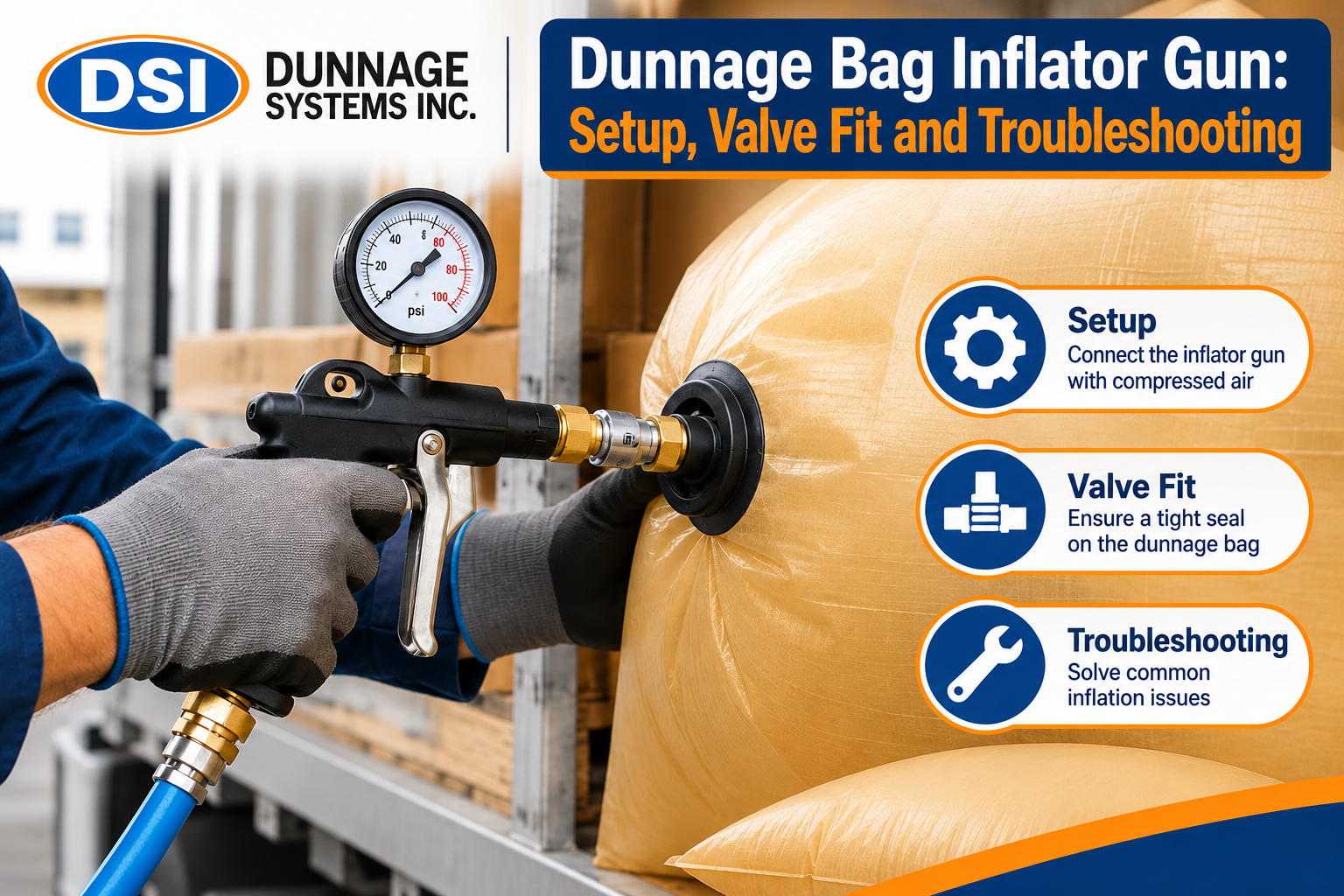
- Inflate to the specified pressure using an airbag inflator with a gauge. Never exceed 10 PSI on Level 4 or Level 5 bags.
- Keep paperwork. Retain the bag level and AAR documentation with your shipping records.
Frequently Asked Questions
What is the difference between Level 4 and Level 5 dunnage airbags?
Level 5 bags are built for the heaviest rail and ocean loads, such as paper rolls, metal coils and brick. Level 4 bags are for heavy industrial rail freight below that range. On Dunnage Systems polywoven bags, both have a 10 PSI maximum pressure.
Do rail shipments require AAR approved dunnage air bags?
In open-top loading, yes: inflatable dunnage bags must be AAR approved and may be used only where a loading figure allows them. For closed cars, follow the applicable AAR loading guidance and the railroad’s requirements.
Can rail dunnage airbags be reused?
Not in open-top loading, where AAR rules allow one loading only. For other rail applications, follow the loading figure and the railroad’s rules.
Who decides which level I need?
The applicable railroad loading figure sets the minimum level when one exists. Otherwise, choose based on load weight and density, and ask your supplier for a recommendation.
What pressure should rail dunnage airbags be inflated to?
Follow the loading figure first. One published figure, for example, calls for an initial 8 PSI on a Level 4 poly bag. Never exceed the bag’s maximum pressure.
Choose the Right Level and Keep Rail Loads in Place
For heavy rail freight, Level 4 dunnage airbags cover most dense industrial loads, while Level 5 is for the heaviest cargo such as paper rolls and metal coils. Whichever you choose, use AAR-approved bags where the rules require them and follow the loading figure for your commodity.
Dunnage Systems supplies rail dunnage airbags with AAR compliance documentation, and our team provides void-fill calculations at no additional charge. Contact us for a rail load recommendation, or ask about our design services.