
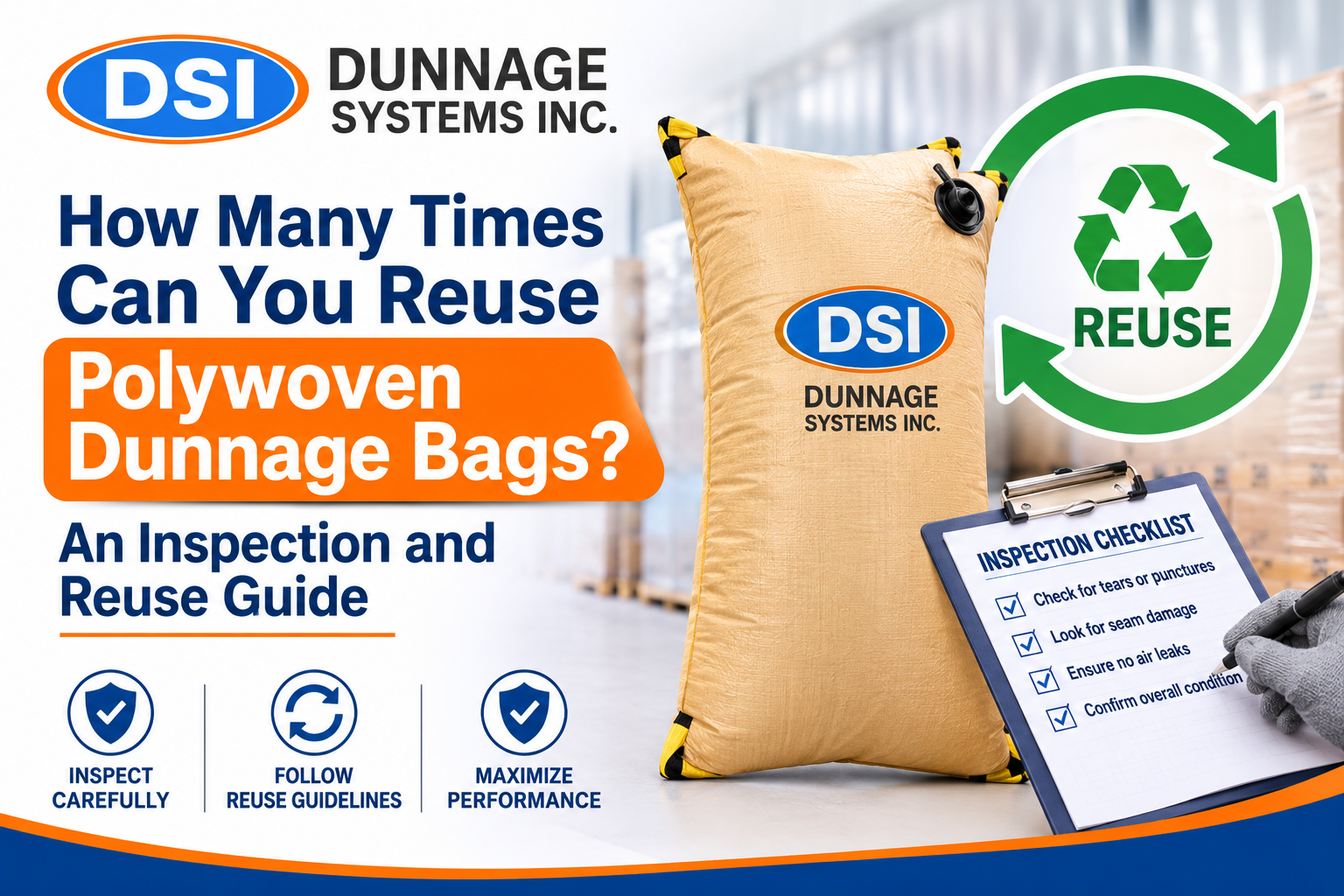
Polywoven dunnage bags are built to come back. Unlike single-use paper bags, they can be deflated at delivery, folded flat and used again on the next outbound load. But reuse only saves money if every bag that goes back into a trailer is still safe to use.
This guide explains what limits how many times reusable dunnage bags can be used, how to inspect them, and when a bag should be retired.
What Makes Polywoven Dunnage Bags Reusable?
Polywoven dunnage air bags are made from elastic woven polypropylene. The woven outer shell resists punctures and abrasion better than paper and tolerates moisture without extra coatings. Dunnage Systems’ polywoven bags also use a quick-deflate removable valve, which lets the bag empty in seconds at the destination without being cut open.
Those features mean a bag can survive unloading in good condition. Whether it survives many trips depends on how it is handled, inspected and stored.
So, How Many Times Can They Be Reused?
There is no fixed number that applies to every bag. The number of safe reuses depends on:
- Load type. Smooth, flat pallet faces cause less wear than cargo with corners, banding or rough edges.
- Inflation practice. Bags inflated to the right pressure last longer than bags that are routinely over-inflated.
- Unloading care. Bags deflated through the valve last longer than bags dragged out, cut or punctured by forklifts.
- Storage. Bags kept clean, dry and out of sunlight hold up better between trips.
- Bag level. Heavier-duty levels use stronger construction.
Dunnage Systems notes that polywoven bags can recover their higher per-unit cost within a few shipment cycles when used correctly. After that, each additional safe reuse lowers your cost per shipment further. The practical rule is simple: reuse a bag for as long as it passes inspection, and not one trip more.
How to Inspect Polywoven Dunnage Bags Before Reuse
Inspect every bag before it goes back into service. A quick, consistent check takes less time than dealing with a failed bag on the road.
1. Check the Woven Shell
Lay the bag flat and look over both faces and the edges. Retire the bag if you find:
- Holes, cuts or tears of any size
- Areas where the weave is frayed, thinned or pulled apart
- Burn marks, melted spots or chemical damage
- Heavy contamination that will not clean off
2. Check the Seams
Run your hand along the seams. Any opening, loose stitching or separation is a reason to retire the bag.
3. Check the Valve
Confirm the valve is present, seats properly, and has no cracks. Make sure the cap or plug closes fully. A valve that does not seal will slowly lose pressure in transit.
4. Do a Hold Test
Partly inflate the bag and leave it for a set time, according to your own procedure. If it loses noticeable pressure, retire it. Mark the time and result if you track bag life.
5. Check the Labels
Make sure the bag’s level or rating marking can still be read. A bag with an unknown rating should not be used where a specific level is required.
Handling Bags at Delivery
Most bag damage happens during unloading, not in transit. Share these steps with your receivers:
- Deflate the bag through the valve before moving any cargo.
- Never cut, puncture or drag a bag out from between loads.
- Remove the bag by hand once it is fully deflated.
- Fold it flat and keep it with other returned bags for collection.
How to Store Reusable Dunnage Bags
Good storage keeps bags ready for the next trip:
- Keep them dry. Polywoven tolerates moisture, but bags should be dry before folding to avoid mold and odor.
- Keep them out of sunlight. Long UV exposure weakens polypropylene over time.
- Keep them off the floor. Store bags on shelves or in bins, away from forklifts and sharp objects.
- Sort by level and size. This prevents a bag of the wrong rating from being used on a heavy load.
When to Retire a Polywoven Dunnage Bag
Take a bag out of service if any of the following apply:
- It fails any step of the inspection above.
- It lost pressure during transit on its last trip.
- Its level or size marking is unreadable.
- It has been used in a rail application that allows one loading only.
That last point matters. AAR open-top loading rules allow inflatable dunnage bags only where a loading figure permits them, require them to be AAR approved, and allow one loading only. Do not reuse a bag on rail freight where the applicable rule says single use. Read more in why rail shipments require AAR-verified dunnage airbags.
Choosing Industrial Poly Woven Dunnage Bags for Reuse
Dunnage Systems offers polywoven bags in Levels 0 to 5, each with its own maximum pressure and approved transport modes. Lower levels suit truck and most intermodal freight, while Levels 3 to 5 are built for rail, intermodal and ocean loads, with AAR compliance documentation available. See the dunnage air bag levels guide to pick the right level.
If your bags rarely come back, single-use kraft paper dunnage bags may cost less overall. For the full picture, read reusable dunnage air bags: benefits and applications.
Frequently Asked Questions
How many times can polywoven dunnage bags be reused?
There is no fixed number. Reuse depends on load type, inflation practice, unloading care and storage. A bag can be reused for as long as it passes inspection; any damage, leak or unreadable rating means it should be retired.
How do you deflate a polywoven dunnage bag?
Dunnage Systems’ polywoven bags use a quick-deflate removable valve. Open the valve and the bag deflates in seconds, without cutting it open.
Can reusable dunnage bags be used for rail shipments?
Yes, at the right level, but check the rules. AAR open-top loading rules allow inflatable dunnage bags for one loading only, so they cannot be reused in those applications.
Are polywoven dunnage bags waterproof?
They are moisture-resistant. Woven polypropylene tolerates moisture better than kraft paper without extra coatings, which makes it a good fit for humid routes.
How should I store reusable dunnage bags?
Store them clean, dry and folded flat, out of sunlight and off the floor. Sort them by level and size so the right bag is used on the right load.
Get More Trips From Every Bag
Polywoven dunnage bags pay off when they come back in good shape and are inspected before every trip. Train receivers to deflate through the valve, store bags properly, and retire any bag that fails inspection.
Dunnage Systems supplies industrial poly woven dunnage bags in Levels 0 to 5, plus inflators and void fillers for closed-loop routes. Talk to our team about a reuse program, or explore polywoven dunnage air bags.