
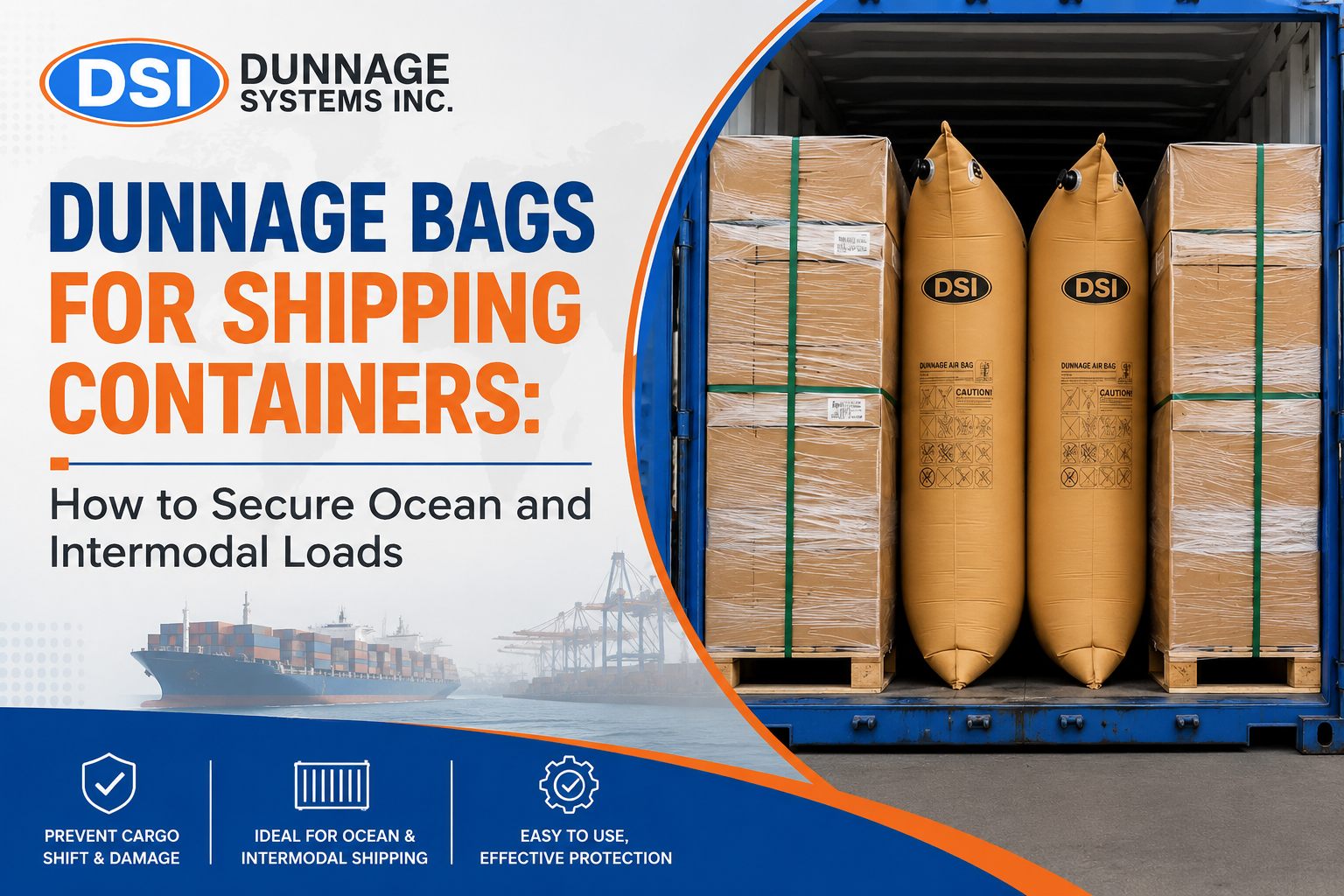
A shipping container can travel by truck, train and ship before it is opened again. Along the way, the cargo inside is pushed forward, backward and sideways many times, and any empty space lets it move. Dunnage bags for shipping containers fill that space so the load stays tight from the shipper’s dock to the consignee’s door.
This guide explains the forces containers face, how to choose the right container dunnage bags, and how to place them so they hold for the whole journey.
Why Containers Need Dunnage Bags
Most container loads have gaps. Pallets rarely match the container’s inside width exactly, and mixed loads leave spaces between rows and at the door end. Those voids give cargo room to slide and build speed before it hits something.
Inflatable dunnage bags, also called air bags for shipping containers, fill those voids quickly. When a bag is inflated between two loads, it presses both against the container walls or neighboring cargo. The load then acts as one solid block that is much harder to shift.
Dunnage bags work by pushing against the cargo and the container itself. That means the container’s structure and the condition of its walls matter as much as the bag.
The Forces a Container Load Faces
A container’s journey includes several types of movement. Each one pushes the load in a different direction.
| Leg of the journey | Main forces on the cargo |
|---|---|
| Road (truck to port or rail yard) | Hard braking forward, acceleration backward, cornering sideways |
| Rail (intermodal moves) | Strong lengthwise shocks during coupling and switching, plus sideways sway |
| Ocean (container ship) | Rolling and pitching in heavy seas, mostly sideways and vertical |
| Port handling | Lifts, set-downs and short impacts during crane and terminal moves |
The CTU Code is the main international guidance for packing containers. It is a joint, non-mandatory code of practice from the International Maritime Organization (IMO), the International Labour Organization (ILO) and the United Nations Economic Commission for Europe (UNECE). For road transport, it uses design forces of 1.0 g forward and 0.5 g backward and sideways. For combined road and rail moves, the figures commonly cited are 1 g lengthwise and 0.5 g sideways.
The practical point is simple: an intermodal container needs securement that can handle stronger lengthwise shocks than a truck-only load.
Choosing the Right Container Dunnage Bags
Polywoven vs. Kraft Paper Bags
Dunnage Systems offers two main bag types for container use.
- Polywoven dunnage air bags are made from woven polypropylene. They resist moisture and are reusable, which helps on humid ocean routes where condensation forms inside containers.
- Kraft paper dunnage bags use layers of kraft paper around a polyethylene liner. They are single-use and recyclable with standard paper waste. Coated kraft options add moisture resistance for humid routes.
For a detailed comparison, see our guide to paper vs. polywoven dunnage air bags.
Matching the Bag Grade to the Route
Bag grade, shown as a level for polywoven bags or a ply count for kraft bags, sets how much load a bag can hold. Based on Dunnage Systems’ product specifications:
| Bag | Rated transport modes |
|---|---|
| Polywoven Level 1 and Level 2 | Truck, intermodal and sea |
| Polywoven Level 3 to Level 5 | Rail, intermodal and ocean (heavier loads) |
| Kraft 4-ply | Truck and ocean |
| Kraft 6-ply and 8-ply | Rail, intermodal and ocean (heavier loads) |
Heavier cargo and routes that include rail need higher grades. Our dunnage air bag levels guide explains each level. When in doubt, ask for a recommendation based on your load weight and route.
Sizing the Bag to the Void
A bag that is too small for the void stretches too far and loses holding strength. A bag that is too large folds and creases. Measure the void at its widest point, and check its height, before choosing a size. Our guide on how to calculate dunnage air bag size walks through the measurements.
How to Place Dunnage Bags in a Shipping Container
Follow these steps for each void:
- Plan the load. Arrange pallets to keep voids small and spread the weight evenly along the container floor.
- Inspect the container. Check walls and floor for protruding nails, splinters or damaged panels that could puncture a bag.
- Measure each void. Record width and height at the widest point.
- Place the deflated bag. Center it in the void, clear of sharp edges, with the valve where you can reach it.
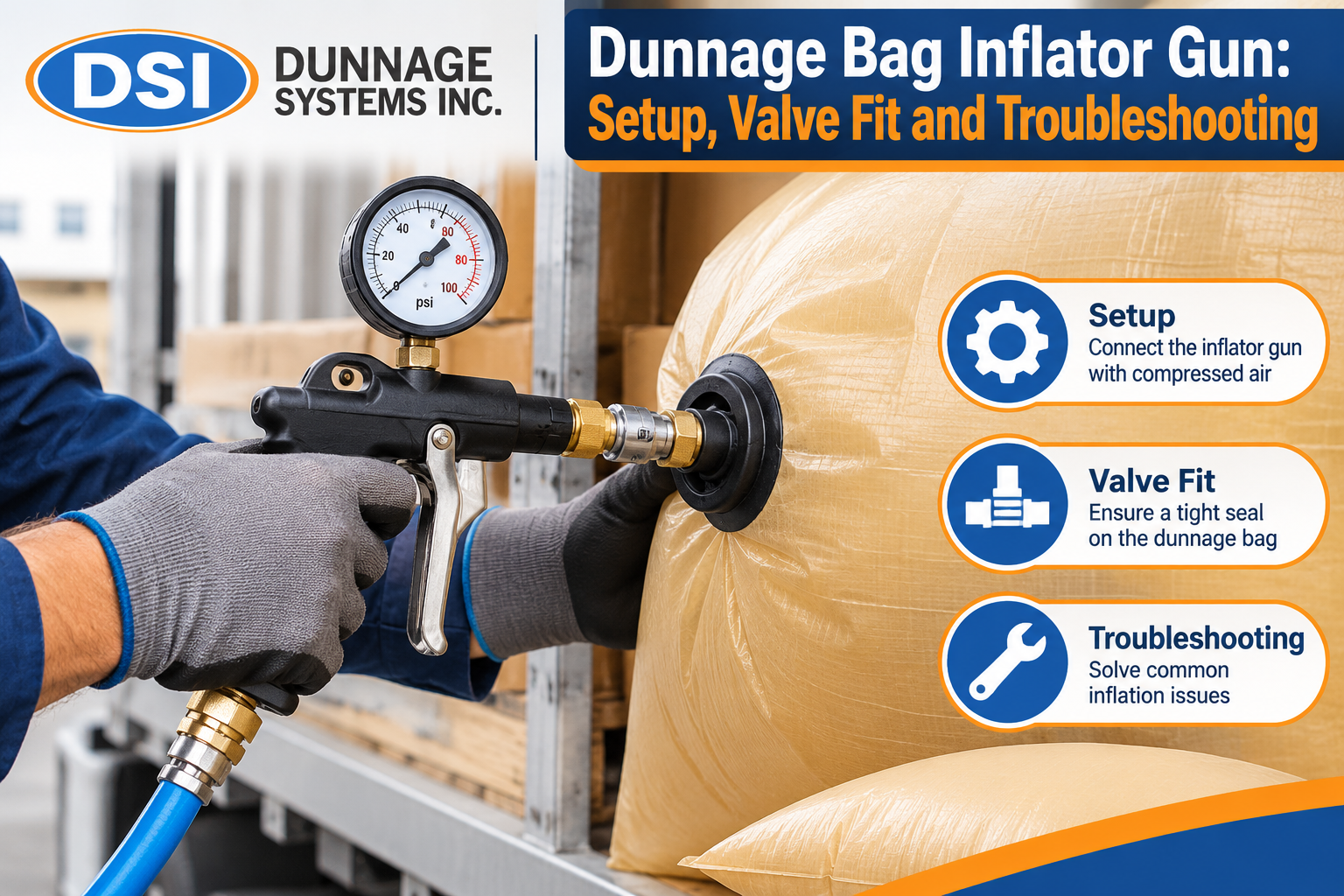
- Inflate gradually. Use an airbag inflator and watch the pressure gauge. Stop when the bag fits firmly.
- Check the fit. On Dunnage Systems bags, a correctly inflated bag compresses no more than half an inch under light palm pressure.
- Recheck before closing. Confirm every bag is in full contact with both load faces.
Protecting Bags From Damage
Bags work best against flat, even surfaces. If a load face has corners, banding or uneven edges, place a smooth sheet between the bag and the cargo. This spreads the pressure and reduces the risk of punctures.
The Door-End Void
The space between the last row of cargo and the container doors needs special care. Many manufacturers advise against inflating a bag directly against the doors, because the doors can be pushed outward and the void is often too large for one bag. Use a rigid void filler or a load bar at the door end, then use dunnage bags for gaps between rows.
Common Mistakes With Container Dunnage Bags
- Using a bag rated only for truck freight on an intermodal move. Rail shocks can exceed what a light-duty bag is built for.
- Over-inflating. Too much pressure can damage cargo or container walls, or burst the bag.
- Bridging large gaps with one bag. If the void is wider than the bag’s rated range, use a void filler or reposition the load.
- Ignoring moisture. Long ocean voyages can cause condensation. Polywoven or coated kraft bags handle it better than standard paper.
- Skipping friction. On smooth container floors, anti-slip rubber mats under pallets help reduce sliding.
Compliance Points for Container Shippers
The CTU Code places responsibility for safe packing on everyone in the chain, including the shipper who packs the container. If the container moves by rail, the railroad’s loading rules can also apply; see why rail shipments require AAR-verified dunnage airbags.
Shippers also need to declare a verified gross mass (VGM) for each packed container before it is loaded onto a ship, under the SOLAS convention. Accurate weights and even weight distribution help both safety and securement.
For a comparison of what each mode needs, read truck vs. rail vs. ocean shipping.
Frequently Asked Questions
What level of dunnage bag is best for ocean containers?
It depends on the cargo weight and whether the container moves by rail. Dunnage Systems’ polywoven Level 1 and Level 2 bags are rated for truck, intermodal and sea moves. Heavier loads, and routes that include rail, call for Level 3 to Level 5 polywoven bags or 6-ply and 8-ply kraft bags.
Can I reuse dunnage bags from a shipping container?
Polywoven bags are designed to be reused if they pass inspection. They deflate quickly through a removable valve and fold flat for storage. Kraft paper bags are single-use and should be recycled after one trip.
Should I put a dunnage bag against the container doors?
Most manufacturers advise against it. The door void is usually large, and pressure on the doors can be unsafe at unloading. A rigid void filler or a load bar is a better choice for the door end.
How tight should a container dunnage bag be?
Inflate the bag gradually until it fits firmly between both load faces. On Dunnage Systems bags, a correctly inflated bag compresses no more than half an inch under light palm pressure. Never exceed the bag’s maximum rated pressure.
Are dunnage bags required by the CTU Code?
No. The CTU Code is a non-mandatory code of practice and does not require any single product. It expects cargo to be secured against movement, and dunnage bags are one recognized way to fill voids and do that.
Keep Container Cargo Tight From Dock to Destination
Dunnage bags for shipping containers are one of the fastest ways to fill voids and stop cargo from shifting at sea, on rail and on the road. The key steps are matching the bag grade to the route, sizing the bag to the void, inflating to the right pressure and protecting the door end with rigid filler.
Dunnage Systems supplies polywoven and kraft container dunnage bags, inflators and void fillers to shippers in all 50 states. Our team offers void-fill calculations and product recommendations at no additional charge. Talk to an expert about your next container load, or explore our dunnage air bags.